Key facts of the era
Key Events
Journey through the events, people, wars and ideas that shaped Norway, from the hunters who followed the retreating ice to the present day.
Follow the rock carvers of Alta and the chieftains of the Iron Age, the Vikings from Lindisfarne to Vinland, Harald Fairhair and Saint Olaf, the civil wars and the golden age of Haakon IV, the Black Death and the Kalmar Union, four centuries with Denmark, the Constitution of Eidsvoll, the union with Sweden and independence in 1905, the German occupation, the welfare state and the oil age.
Meet the kings, earls and regents who ruled Norway, and the first ministers and prime ministers who governed it.
From Harald Fairhair and the Earls of Lade through the kings of the civil wars and the golden age, the union kings of the Kalmar Union, Denmark–Norway and Sweden–Norway, to the House of Glücksburg since 1905, with the regents of the interregna and the first ministers and prime ministers who governed Norway.
A Journey Through the Ages
Norway, the long Atlantic coast between the North Sea and the Arctic Ocean, was settled by hunters as soon as the ice withdrew, about 9500 BCE; the rock carvings of Alta and the Bøla reindeer record their world. Farming reached the Oslofjord about 4000 BCE, bronze and then iron followed, and in the Iron Age chieftains ruled from great halls in the south while the Sámi hunted, fished and trapped in the north.
From the raid on Lindisfarne in 793 Norwegian Vikings sailed west to Shetland, Orkney, Ireland, Iceland, Greenland and North America. Saga tradition makes Harald Fairhair the first king of all Norway after Hafrsfjord, traditionally dated 872; Olaf Tryggvason and Saint Olaf brought Christianity, and after a century of civil wars Haakon IV ruled a realm stretching from Greenland to Bohuslän.
The Black Death of 1349 and the end of the old royal line drew Norway into unions with Sweden and Denmark. From 1537 it was ruled from Copenhagen as part of Denmark–Norway, a Lutheran kingdom that kept its own laws but lost Jämtland, Härjedalen and Bohuslän to Sweden. In 1814 Norway refused to be handed over to Sweden, adopted the Eidsvoll Constitution on 17 May and entered a union with Sweden as a separate state, which the Storting dissolved peacefully in 1905.
The independent kingdom of Haakon VII explored the poles, stayed neutral in the First World War and was occupied by Germany from 1940 to 1945, while the King and government fought on from London. After the war Norway joined NATO, built a welfare state, found oil in the North Sea in 1969 and twice voted against joining Europe. King Harald V died in August 2026 and was succeeded by his son, Haakon VIII. Explore the ten ages below through selected events from the timeline.

12,000 BCE – 792
Hunters, rock carvers and chieftains.
Hunters followed the retreating ice up the Norwegian coast: the Fosna culture dates from about 9500 BCE, Komsa hunters reached Finnmark by about 9300 BCE, and the Søgne woman of about 7500 BCE is the oldest human known from Norway. Around 6200 BCE the Storegga Slide sent a tsunami along the coast. Hunters carved reindeer, elk and boats at Alta and Bøla, farming reached the Oslofjord about 4000 BCE, and bronze arrived about 1700 BCE, when farmers carved ships into the rocks of Østfold. A distinct Sámi culture took shape in the north. Iron from bog ore spread after 500 BCE, the first runes were cut on the Øvre Stabu spearhead and the Tune stone, and after the crisis of 536 chieftains ruled from great halls, were buried at Borre and Avaldsnes, and founded the trading town of Kaupang.

Hunter-gatherers followed the newly ice-free coast northwards from about 9500 BCE.

An undersea landslide off the Møre coast sent a tsunami along Norway about 6200 BCE.

A spearhead from Øvre Stabu in Toten, about 180, bears one of the oldest runic inscriptions known.

Norway's first town grew at Skiringssal in Vestfold around 800, trading as far as the Arab world.

793 – 1034
Raiders, settlers and the first kings.
The raid on Lindisfarne in 793 opened the Viking Age. Norwegians settled Shetland, Orkney, the Hebrides, Man and the Faroes, founded Dublin in 841 and, from about 874, Iceland, and from there reached Greenland and Vinland in North America. The Oseberg and Gokstad ships were buried in Vestfold. Saga tradition makes Harald Fairhair the first king of all Norway after the Battle of Hafrsfjord, dated 872 by tradition but placed in the 880s by many historians; his kingdom was centred on the west coast, and for a century his heirs competed with Danish overlords and the Earls of Lade. Olaf Tryggvason and Olaf Haraldsson imposed Christianity by force, and Olaf's death at Stiklestad in 1030 and canonisation a year later made him Norway's eternal king.

Norse raiders sacked the monastery on Holy Island in Northumbria on 8 June 793.
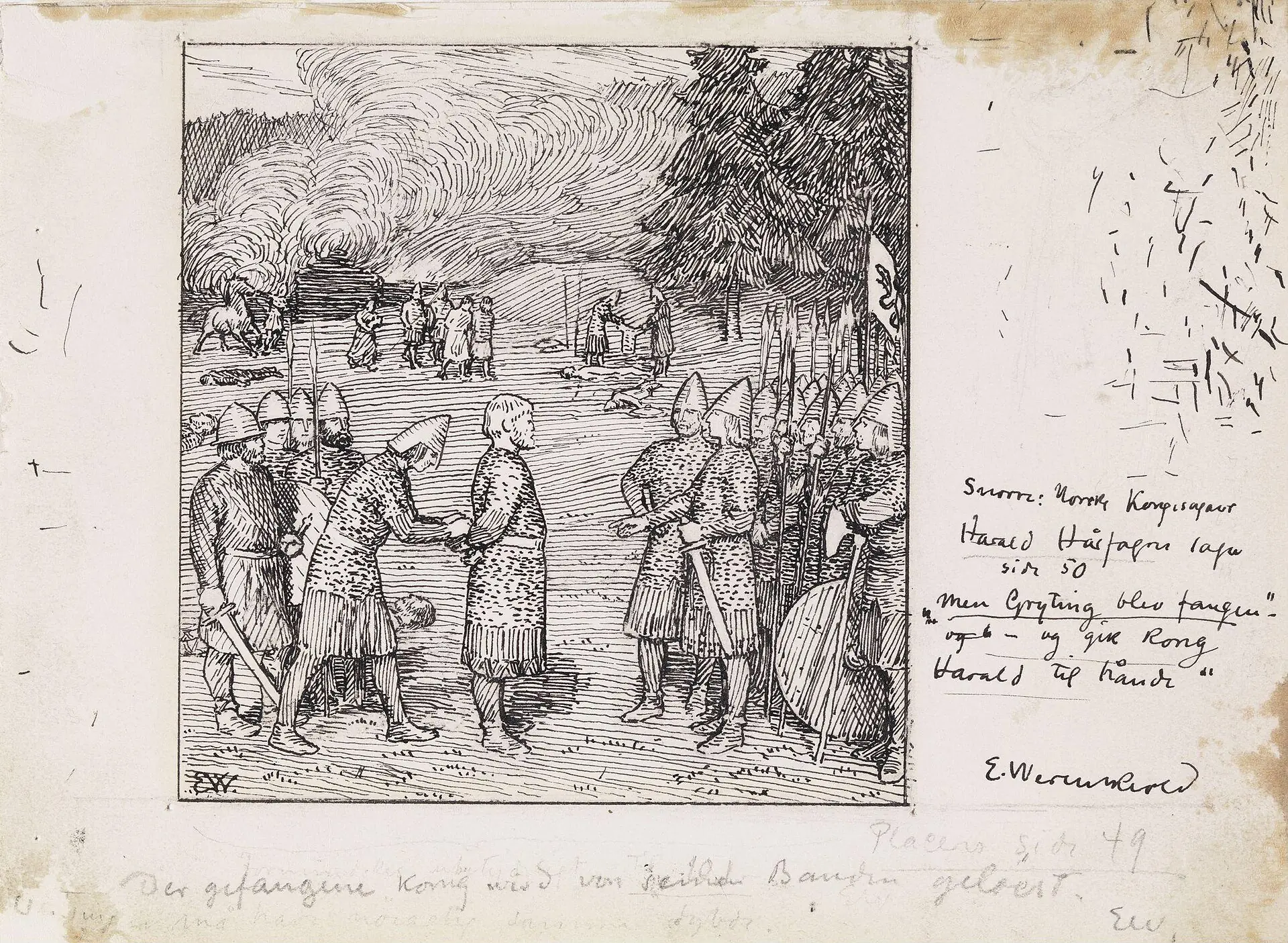
Saga tradition makes him the first king of all Norway after Hafrsfjord, traditionally dated 872.

Leif Erikson sailed from Greenland to the coast of North America around 1000.

Olaf Haraldsson fell fighting a farmers' army in 1030 and was declared a saint a year later.

1035 – 1239
Sea-kings, saints and civil war.
Magnus the Good, recalled from Kievan Rus' in 1035, also won Denmark, and Harald Hardrada ruled until he fell invading England at Stamford Bridge in 1066. Under Olaf Kyrre's long peace Oslo and Bergen grew into towns and the church gained fixed dioceses; Magnus Barefoot won the Hebrides and Man, and Sigurd the Crusader sailed to the Holy Land. With no fixed rule of succession, Sigurd's death in 1130 opened more than a century of civil wars between rival kings and pretenders. Nidaros became an archbishopric about 1153, Magnus Erlingsson received the first coronation in Scandinavia, and Sverre's Birkebeiners won the kingdom at Fimreite in 1184 and fought the church-backed Baglers. Sverre's grandson Haakon IV, confirmed king in 1223, outlasted Duke Skule's rebellion of 1239–1240, the last of the wars.

Harald Hardrada fell invading England on 25 September 1066, three weeks before Hastings.

Olaf Kyrre founded a market town at Bjørgvin around 1070, on the main sailing route along the coast.

About sixty ships left Norway in 1107 on the first crusade led by a European king.

Skiers carried the infant Haakon, Sverre's grandson, over the mountains to safety about 1206.

1240 – 1318
The realm at its greatest extent.
Haakon IV, crowned by a papal legate in 1247, and his son Magnus the Lawmender ruled the Norwegian realm at its greatest extent. Greenland accepted Norwegian rule in 1261 and Iceland in 1262–1264, and the crown held Orkney, Shetland, the Faroes, Jämtland and Bohuslän. Haakon's expedition to defend the Hebrides failed at Largs in 1263, and the Treaty of Perth of 1266 ceded the Hebrides and Man to Scotland. Magnus's Law of the Land of 1274 was one of Europe's first national law codes, and the Concordat of Tønsberg settled the rights of king and church. The King's Mirror and Haakon's Hall in Bergen reflect a confident court culture, but the Hanseatic blockade of 1284 showed the power of the German towns. Haakon V built Akershus and Vardøhus and curbed the nobility.

Greenland in 1261 and Iceland in 1262 accepted the Norwegian king as their ruler.

After the failed expedition of 1263 Norway ceded the Hebrides and Man to Scotland in 1266.

Magnus the Lawmender's Law of the Land of 1274 was one of Europe's first national law codes.

Haakon V built a stone castle above Oslo around 1300; it withstood a Swedish siege in 1308.

1319 – 1536
Plague, the Hanse and the Kalmar Union.
On Haakon V's death in 1319 his three-year-old grandson Magnus Eriksson inherited Norway and was elected king of Sweden, the first of the unions that shaped the next two centuries. The Black Death reached Bergen in 1349 and killed perhaps half the population, weakening nobility, church and crown, while the Hanseatic Kontor at Bryggen dominated the stockfish trade. Haakon VI's marriage to Margaret of Denmark brought union with Denmark in 1380, and when the royal line died out in 1387 Margaret ruled all three kingdoms, joined in the Kalmar Union of 1397. Norse Greenland vanished from the record after 1408, rebellions against union kings failed, and Orkney and Shetland were pledged to Scotland in 1468–1469. After Sweden left the union in 1523, Christian III declared in 1536 that Norway should cease to be a kingdom.

A ship from England brought the plague to Bergen in 1349; perhaps half the people died.

German merchants of the Hanseatic League ran the stockfish trade from their Kontor in Bergen.
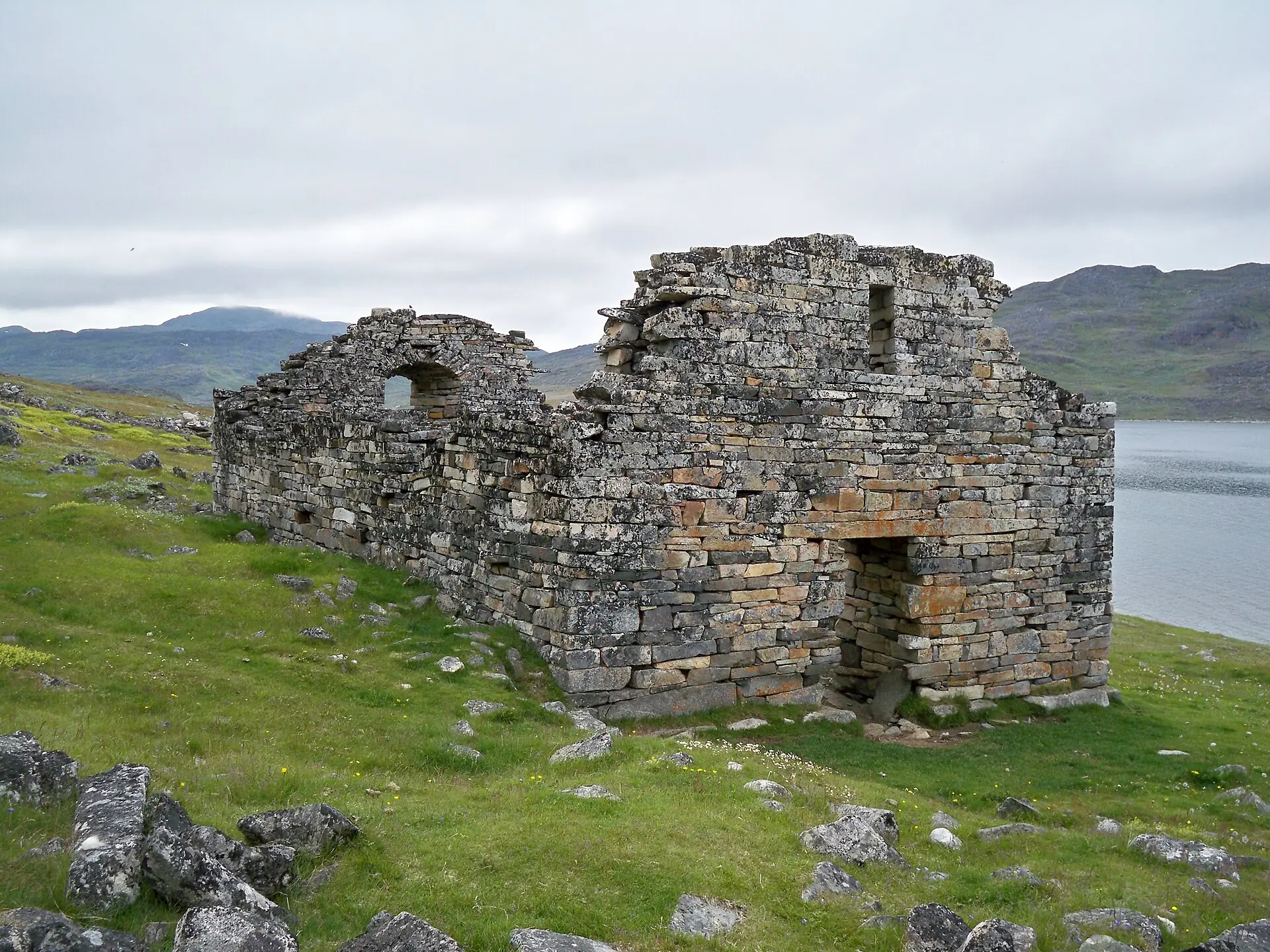
A wedding at Hvalsey Church in 1408 is the last written record of the Norse Greenlanders.

Christian I pledged the islands to Scotland in 1468–1469 for his daughter's dowry.

1537 – 1813
Ruled from Copenhagen.
In 1537 the Reformation was imposed, the last archbishop fled and the Norwegian Council of the Realm ceased to meet; for almost three centuries Norway was ruled from Copenhagen, but it kept its own law, renewed in 1604 and in Christian V's Norwegian Code of 1687. Timber, fish, Kongsberg silver and Røros copper brought wealth, and Christian IV founded Christiania and Kristiansand. Wars with Sweden cost Jämtland and Härjedalen in 1645 and Bohuslän in 1658, though Trøndelag was won back. Absolute monarchy came in 1660–1661. In the Great Northern War Charles XII was killed before Fredriksten, Pietism brought confirmation and rural schools, and writers from Holberg to the Norwegian Society nurtured a Norwegian identity. The Napoleonic Wars brought blockade and hunger, and in 1811 Norway gained its first university.

Archbishop Olav Engelbrektsson fled in 1537 as Lutheranism was imposed from Copenhagen.

At Roskilde in 1658 Norway lost Bohuslän for good; Trøndelag, ceded with it, was retaken.

Charles XII of Sweden was killed in the siege trenches before the fortress at Halden in 1718.

In 1811 Frederick VI granted Norway its first university, in Christiania.

1814 – 1905
A constitution, a union and a nation.
When Denmark ceded Norway to Sweden at Kiel in January 1814, the Norwegians refused: the assembly at Eidsvoll adopted a liberal constitution on 17 May and elected Christian Frederik king. After a brief war the Convention of Moss preserved the constitution, and on 4 November Norway entered a union with Sweden as a separate kingdom with its own Storting, government, bank and army. The Storting abolished the nobility, local self-government and railways followed, and hundreds of thousands emigrated to America. National romanticism collected folktales and dialects, and Ibsen, Bjørnson, Grieg and Munch won European fame. The impeachment of 1884 brought parliamentary government and the first parties, all men gained the vote in 1898, and after the consular dispute the Storting dissolved the union on 7 June 1905, confirmed by referendum.

The sloop Restauration sailed for America in 1825; hundreds of thousands followed.

Ibsen's Nora shocked audiences across Europe when she walked out in 1879.
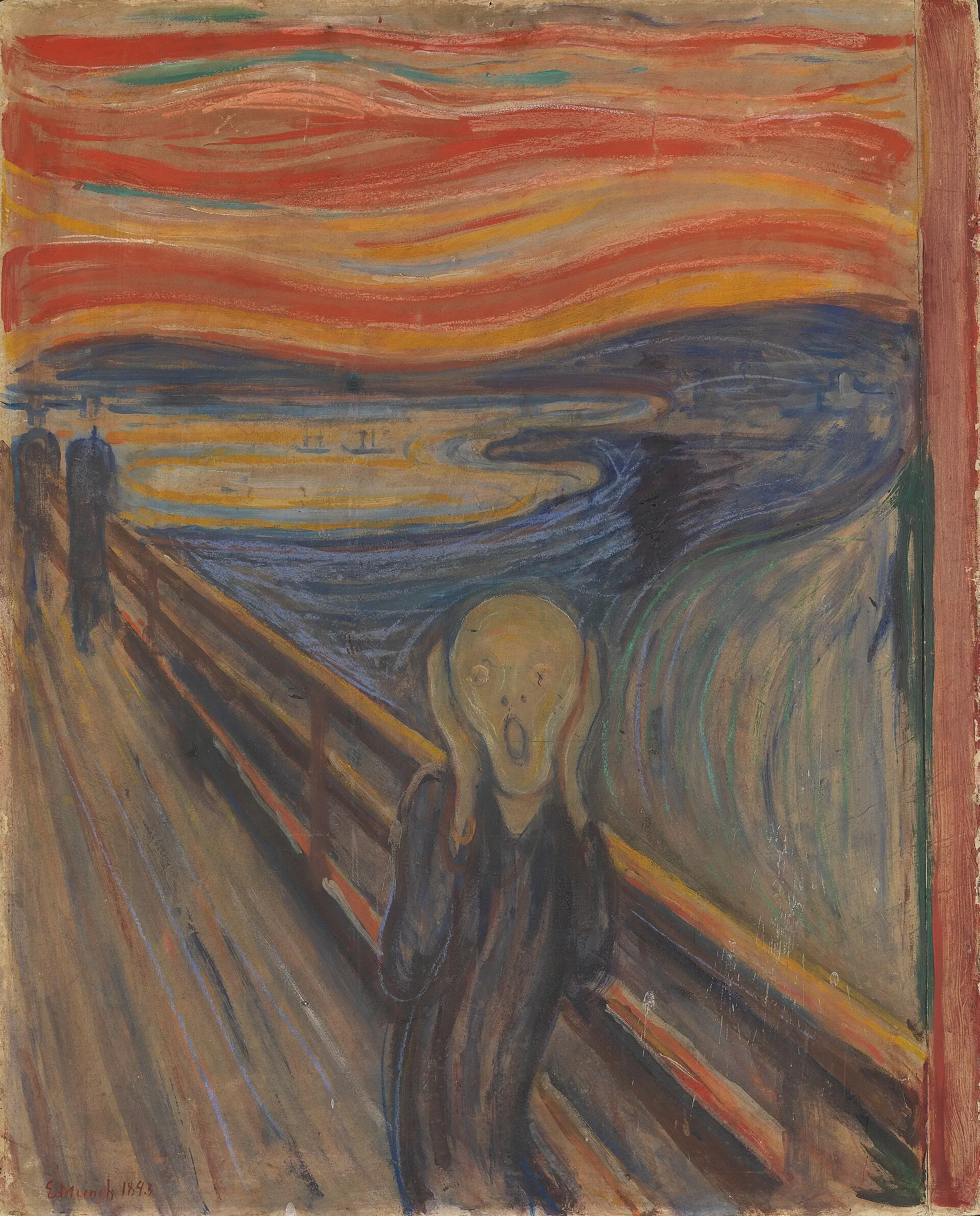
Edvard Munch painted the first version of his icon of modern anxiety in 1893.

On 7 June 1905 the Storting declared the union with Sweden dissolved.

1905 – 1945
Independence, the poles and occupation.
Prince Carl of Denmark became King Haakon VII in November 1905. Independent Norway built industry on hydropower, gave women the vote on equal terms in 1913 and sent Amundsen to the South Pole. Neutral in the First World War, it lost close to half its merchant fleet. The Svalbard Treaty of 1920 and new claims in the Arctic and Antarctic extended its territory, and Labour came to power in 1935 under the crisis agreement. On 9 April 1940 Germany invaded; the King refused to appoint Quisling, and after a 62-day campaign he and the government continued the war from London with the merchant fleet. At home Terboven and Quisling's regime ruled, the resistance grew, more than 770 Jews were deported, and the north was burned before the Germans capitulated on 8 May 1945.

In 1913 the Storting gave women the vote on the same terms as men.

The Svalbard Treaty of 1920 recognised Norwegian sovereignty over the Arctic archipelago.

At Nybergsund on 10 April 1940 Haakon VII refused to appoint a Quisling government.

Norwegian commandos destroyed the heavy-water cells at Vemork in February 1943.

1945 – 2000
Rebuilding, welfare and North Sea oil.
After liberation Einar Gerhardsen's Labour governments rebuilt the country with planning and Marshall aid, and Norway gave up neutrality to join NATO in 1949; Trygve Lie became the first UN Secretary-General. Oslo hosted the 1952 Winter Olympics, and the National Insurance Scheme of 1967 completed a universal welfare state. In 1969 the Ekofisk find opened the oil age: the state created Statoil and kept control of the continental shelf, and oil and gas made Norway one of the world's richest countries, at the cost of disasters such as the Alexander L. Kielland platform in 1980. Voters rejected Europe in 1972 and 1994, but the EEA joined Norway to the single market. Gro Harlem Brundtland led three governments, the Sámi Parliament opened in 1989, and the Petroleum Fund was set up in 1990.

Norway gave up neutrality and signed the North Atlantic Treaty as a founding member in 1949.

From 1967 the National Insurance Scheme brought pensions and benefits into one universal system.

Voters rejected the European Communities in 1972 and the European Union in 1994.

Gro Harlem Brundtland became Norway's first woman prime minister in 1981.

2001 – present
Wealth, tragedy and a new reign.
The fiscal rule of 2001 limited spending to the expected return of the oil fund, which grew into the world's largest sovereign wealth fund, with ethical guidelines from 2004. Norway opened the Oslo Opera House and the Svalbard Global Seed Vault, introduced gender-neutral marriage, settled its Barents Sea border with Russia and separated the Church of Norway from the state. On 22 July 2011 a far-right terrorist killed 77 people in Oslo and on Utøya. Governments alternated between Stoltenberg, Solberg and, from 2021, Jonas Gahr Støre. After Russia's invasion of Ukraine Norway armed Ukraine, became Europe's largest gas supplier and planned a large rise in defence spending, while electric cars came to dominate new sales. King Harald V died on 28 August 2026 and was succeeded by his son, Haakon VIII.

A vault in the Svalbard permafrost has safeguarded the world's crop seeds since 2008.

A far-right terrorist killed 77 people in the government quarter in Oslo and on Utøya in 2011.

In 2025 fully electric cars made up 95.9 per cent of new car sales.

King Harald V died on 28 August 2026, and his son became King Haakon VIII.
Norway’s Lands Through Time, c. 9000 BCE – Today
Follow Norway’s lands from the first hunters on an ice-free coast, through the petty kingdoms and the Viking settlements from Dublin to Greenland, the medieval realm and its tributary islands, four centuries with Denmark and the lands lost to Sweden, the union with Sweden, independence and the Arctic, to the Norway of today. Each of 46 zones is coloured by who held it, in 30 narrated chapters.
If the page stays blank, the site doesn't allow embedding — use “Open in new tab”.
From the rock carvings of Alta to the oil fund, the history of Norway has left the sagas and the stave churches, a seafaring tradition that reached from Dublin to Vinland, two written forms of Norwegian, one of the world's oldest written constitutions still in force, the plays of Ibsen and the paintings of Munch, the polar journeys of Nansen and Amundsen, the memory of occupation and resistance, and a wealthy welfare state that has chosen to save its oil money for future generations.
Runes were cut in Norway from about 180, and the kings' sagas written in Iceland, above all Snorri Sturluson's Heimskringla, made Norway's early kings famous. Under Denmark, Danish became the written language; in the nineteenth century Ivar Aasen built Nynorsk on the rural dialects while Dano-Norwegian grew into Bokmål, and both remain official. The Sámi languages have official status, and Jon Fosse, who writes in Nynorsk, won the Nobel Prize in Literature in 2023.
Viking ships such as Oseberg and Gokstad carried Norwegians to the British Isles, the Faroes, Iceland, Greenland and Vinland, and Norse place names and law survive across the North Atlantic. Later the merchant fleet became one of the largest in the world and served the Allies in the Second World War. Nansen crossed Greenland and drifted across the Arctic in Fram, Amundsen was first through the Northwest Passage and first at the South Pole, and Heyerdahl crossed the Pacific on Kon-Tiki.
The regional assemblies of the Gulating and Frostating, Magnus the Lawmender's national law of 1274 and the Norwegian Codes of 1604 and 1687 kept Norway a land of its own law even under Danish rule. The Eidsvoll Constitution of 17 May 1814, still in force and celebrated every Constitution Day, gave power to an elected Storting; the impeachment of 1884 established parliamentary government, and the vote was extended to all men in 1898 and to women in 1913.
Norway's medieval stave churches, with Urnes and Borgund the best known, joined Viking ornament to Christian architecture, and Nidaros Cathedral rose over the shrine of Saint Olaf, the goal of pilgrims for centuries. The Rock Art of Alta, Urnes Stave Church, Bryggen in Bergen and the mining town of Røros are among Norway's UNESCO World Heritage Sites, and the Oseberg and Gokstad ships are among the best-preserved Viking ships ever found.
In the late nineteenth century a small country produced world-famous art. Henrik Ibsen's Peer Gynt, A Doll's House and Hedda Gabler changed modern drama, Edvard Grieg's music for Peer Gynt and his piano concerto drew on Norwegian folk music, and Edvard Munch's The Scream became an icon of modern anxiety. Bjørnson, Hamsun and Undset won Nobel Prizes in Literature, and Bjørnson's Ja, vi elsker dette landet became the national anthem.
The five years of German occupation from 1940 to 1945 shaped modern Norway: the King's refusal to appoint Quisling, whose name became a byword for traitor, the government in exile, the merchant fleet, the Home Front and the saboteurs of Vemork. The deportation of Norway's Jews, the burning of Finnmark and North Troms and the post-war legal purge are remembered too, and the experience led Norway to abandon neutrality and help found NATO in 1949.
Since 1901 a committee appointed by the Storting has awarded the Nobel Peace Prize in Oslo. Fridtjof Nansen's work for refugees, Trygve Lie as the first Secretary-General of the United Nations, the Brundtland Report on sustainable development and the Oslo Accords of 1993 made Norway a voice in international affairs. Norway twice voted against joining the European Union but is bound to Europe through the EEA, and is a founding member of NATO.
Hydropower built Norway's first industries, and the National Insurance Scheme of 1967 completed a universal welfare state. The discovery of Ekofisk in 1969 made Norway one of the world's richest countries; the state kept control through Statoil, today Equinor, and saves its oil revenue in the Government Pension Fund Global, the world's largest sovereign wealth fund, spending only its expected return. Today almost all new cars sold in Norway are electric.
The timeline is built from the project's own research dossier and its event, ruler, prime minister and map datasets, checked against English Wikipedia, Store norske leksikon, Norsk biografisk leksikon, norgeshistorie.no, Encyclopaedia Britannica, the Government of Norway, the Royal House and other references. Linked articles are starting points for verification, not proof that every claim has been independently checked. Prehistoric dates and the reigns of the Viking Age rest on archaeology and on sagas written two or three centuries later and are approximate; Harald Fairhair's victory at Hafrsfjord is shown at the traditional 872, which many historians place in the 880s. Dates follow the New Style where sources give one, conflicting figures are both given, the most recent events rest on sources that are still changing, and the map's historical zones are reconstructions.
Every event and every ruler has its own sources. See Sources & Further Reading in each timeline entry and ruler profile.
History is connected. Explore the bigger picture.
AllHistories is an independent visual history project designed to make the past easier to understand, explore, and connect.
History is more than a collection of dates, rulers, and battles. Events rarely happen in isolation. Borders shift, civilizations influence one another, ideas spread, and decisions made centuries ago continue to shape the world today.
Through interactive timelines, historical maps, and visual storytelling, AllHistories helps uncover these connections and makes complex historical subjects more accessible and engaging.
Travel through centuries, discover turning points, and understand how historical events unfold and connect.
Explore how borders, civilizations, populations, trade routes, beliefs, and spheres of influence have changed over time.
Go beyond dates and discover the individuals, places, decisions, and circumstances behind historical developments.
Explore connections between countries, empires, civilizations, and historical themes to better understand cause and consequence.
Features vary depending on the historical subject.
AllHistories draws on historical research, published references, public archives, and available historical datasets. The information is organized and presented through interactive digital experiences.
History is not always certain or universally agreed upon. Dates, territorial boundaries, population figures, and interpretations may differ between sources. Some information is necessarily simplified or estimated for visual presentation.
The goal is to encourage curiosity and independent exploration, not to replace academic publications or specialist historical research.
When you visit AllHistories, the web server may process technical information such as your IP address, requested pages, browser details and access times to deliver pages and maintain the service.
Some pages load Google Analytics, Google Fonts, externally hosted images, maps or other third-party resources. Requests to these providers can transmit technical information, including your IP address. Contact forms may use Google reCAPTCHA to help prevent abuse. These providers apply their own privacy policies.
The website uses browser storage for preferences such as the selected theme. Country microsites also use a session cookie to support website functionality, including request protection. Analytics or other third-party services may use additional cookies or storage, depending on the page and your browser settings.
When you submit a correction or contact form, the information you provide, such as your name, email address and message, is processed to review and respond to your request. Please avoid including sensitive personal information.
You can manage cookies and site storage in your browser and control third-party requests through browser privacy settings. For privacy questions or requests concerning information you submitted, use the contact option on the microsite where you sent it.
Links to sources and other websites take you to services with their own privacy practices. Review their policies before providing personal information.
AllHistories provides historical information for general education and exploration. Its content is not professional, legal, financial or other specialist advice.
We aim to present useful, well-sourced summaries, but cannot guarantee that every date, statement, translation or interpretation is complete or accurate. Verify important claims against the cited sources and relevant scholarship. Content may be corrected or updated.
Maps are simplified historical illustrations. Borders, place names and territorial labels may vary by period and source. Their appearance does not express a position on sovereignty or present-day territorial disputes.
Images and source material may belong to their respective creators or rights holders. Consult the image credit, source page and license before reusing material. A link or credit does not grant additional reuse rights.
External links are provided for reference. AllHistories does not control the content, availability or policies of third-party websites.
To report an error or a concern about credited material, use the contact option on the relevant country microsite and identify the page, material and supporting details.