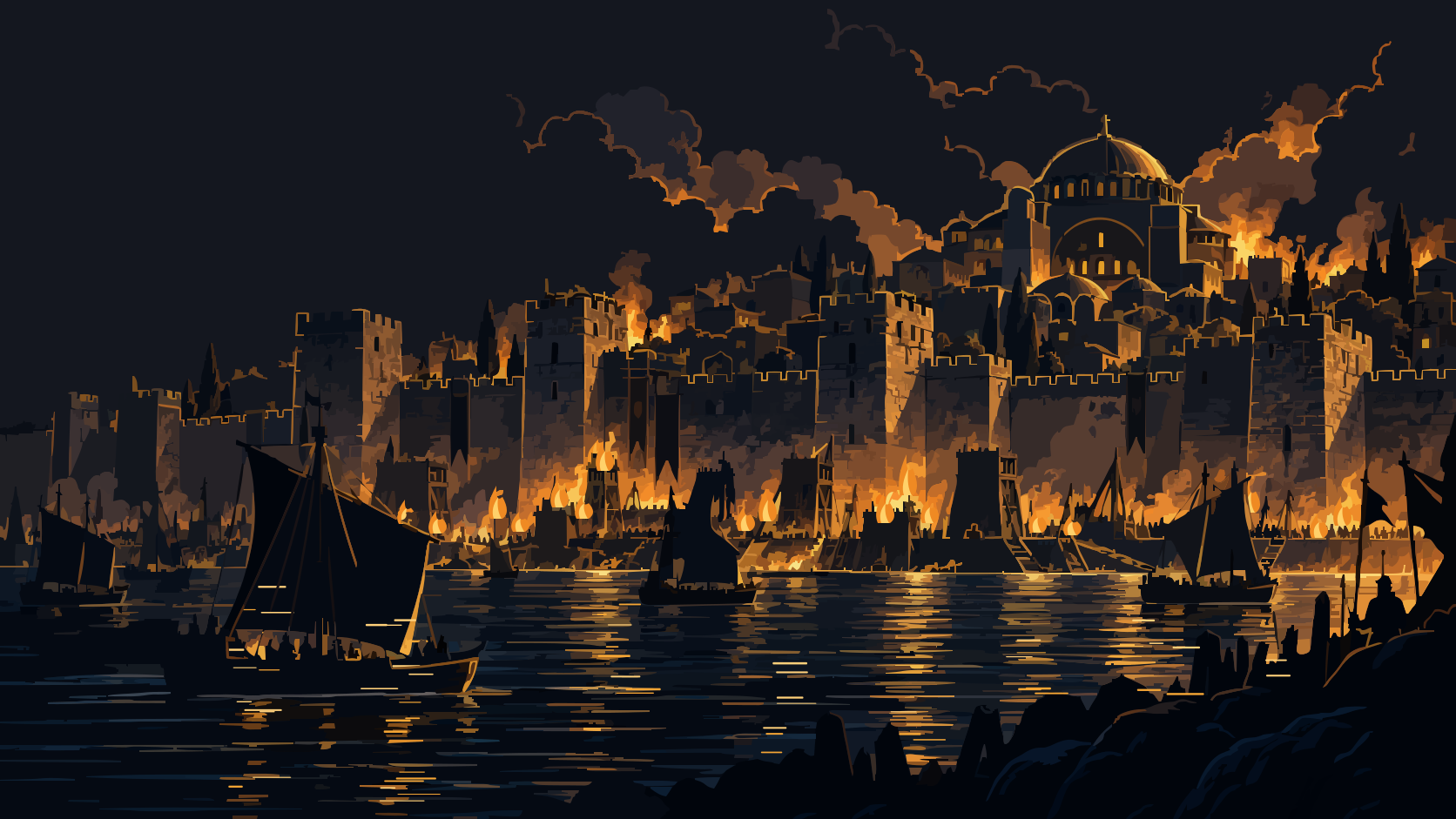
The End of
an Empire
A 21-year-old sultan, a 49-year-old emperor, the biggest gun on Earth and a city that had never been taken by land. The story of the 53 days that ended eleven centuries of Rome — and the myths they left behind.
For eleven centuries Constantinople was the largest, richest and best-defended city in Europe. Its triple land wall, built in 413, had turned back Avars, Arabs, Bulgars and Rus'. Only once, in 1204, had it fallen — to Christian crusaders who came by sea.
By 1453 the walls still stood, but almost nothing else did. Plague, civil war and the Ottoman advance had reduced an empire that once reached from Spain to Syria to a single city of fewer than 50,000 people, a handful of islands and a province in southern Greece. Fields grew inside the walls. The Great Palace was a ruin. The emperor could not pay a gun-founder's wages.
Hover the chart to watch the empire shrink.
The fall was not a sudden catastrophe but the last act of a long one. Choose a chapter to follow the timeline; the most important events are marked in bold.
Along twenty kilometres of wall, fewer than eight thousand defenders — a third of them Italian volunteers — faced the largest army and the largest guns the Ottomans had ever assembled. Numbers below are modern estimates; eyewitnesses claimed far more.
The chain across the Golden Horn had stopped every fleet for centuries, and it stopped Mehmed's. So he went around it.
On a single night the Ottomans laid a greased wooden track from Tophane on the Bosporus, over the ridge behind Galata, and down to Kasımpaşa inside the harbour. By morning about seventy ships had been hauled across, sails up and oars beating in the air, to the astonishment of both sides. The defenders now had a second front along the harbour walls, and the city's last secure flank was gone.
A Venetian attempt to burn the ships on 28 April was betrayed or discovered; forty captured sailors were impaled in sight of the walls, and the defenders beheaded 260 Ottoman prisoners in reply.
Seven eras, a slider through all 58 days, the chain, the camps, the overland route and the three assault waves. Every marker links to its source.
Opens in a full-screen window. Or open the map page directly →
On 28 May the Ottoman camp fell silent for prayer. In the city, Catholics and Orthodox worshipped together in Hagia Sophia for the first and last time. The emperor took communion, asked forgiveness of his officers, and rode back to the Mesoteichion. The attack came soon after midnight.
Thousands of bashi-bazouks are thrown at the stockade in the Lycus valley. After two hours of slaughter they are pulled back. Their job was to tire the defenders.
Disciplined provincial regiments attack under a thunderous bombardment. Three hundred break through the stockade and are killed to a man.
Mehmed leads his elite infantry to the breach himself. Giustiniani is hit; carried to a ship, his men follow him. Somewhere to the north, Doukas says, a small gate stands open.
The emperor throws off his purple and vanishes into the fighting. By midday the Ottoman banner flies over the walls, the ships are escaping down the Marmara, and the sack has begun.
“All of us have reached the mutual decision to die.”Constantine XI to his officers, 28 May 1453
Some consequences were immediate and total. Others are credited to 1453 by habit more than by evidence. Each card carries a verdict.
Counterfactual history is speculation, and these scenarios are labelled as such. Each one asks what would plausibly have followed, and rates how much the world would have changed. Click to open.
In Greece 29 May is a day of mourning and Tuesday is still unlucky; in Istanbul the same date is Fetih, the Conquest, celebrated with fireworks. The building at the centre of both stories has changed its name three times in a century.
The name — from the Greek eis tin polin, "to the city" — had been used for centuries. It became the only official one in 1930.
Mosque in 1453, museum under Atatürk in 1934, and a mosque again from 24 July 2020.
Greek legend says an angel turned Constantine to marble and hid him beneath the Golden Gate, to wake when the city is Greek again.
Re-enactments, concerts and the banner of Ulubatlı Hasan: the conquest is a founding story of modern Turkey.
Every event, person and fact on this site links to its source. Dates for 1453 follow the Julian calendar (29 May Julian = 7 June Gregorian). Figures for troops, guns and casualties vary between sources and are given as ranges.
AllHistories is a visual guide to understanding how the past connects. Through interactive timelines, maps and visual storytelling, it makes complex events and long-term processes easier to follow. It is an invitation to explore, ask questions and discover connections, rather than a definitive historical account or a substitute for scholarly research.
The microsites bring together historical summaries and links to sources. Evidence varies by period and subject: dates may be approximate, interpretations may be disputed, and new research can change our understanding. Counterfactual scenarios are speculative.
If you spot an error or want to suggest a source, use the “Noticed a mistake?” contact option on the relevant country timeline. Please include the page or event and a source supporting the correction.
When you visit AllHistories, the web server may process technical information such as your IP address, requested pages, browser details and access times to deliver pages and maintain the service.
Some pages load Google Analytics, Google Fonts, externally hosted images, maps or other third-party resources. Requests to these providers can transmit technical information, including your IP address. Contact forms may use Google reCAPTCHA to help prevent abuse. These providers apply their own privacy policies.
The website uses browser storage for preferences such as the selected theme. Country microsites also use a session cookie to support website functionality, including request protection. Analytics or other third-party services may use additional cookies or storage, depending on the page and your browser settings.
When you submit a correction or contact form, the information you provide, such as your name, email address and message, is processed to review and respond to your request. Please avoid including sensitive personal information.
You can manage cookies and site storage in your browser and control third-party requests through browser privacy settings. For privacy questions or requests concerning information you submitted, use the contact option on the microsite where you sent it.
Links to sources and other websites take you to services with their own privacy practices. Review their policies before providing personal information.
AllHistories provides historical information for general education and exploration. Its content is not professional, legal, financial or other specialist advice.
We aim to present useful, well-sourced summaries, but cannot guarantee that every date, statement, translation or interpretation is complete or accurate. Verify important claims against the cited sources and relevant scholarship. Content may be corrected or updated.
Maps are simplified historical illustrations. Borders, place names and territorial labels may vary by period and source. Their appearance does not express a position on sovereignty or present-day territorial disputes.
Images and source material may belong to their respective creators or rights holders. Consult the image credit, source page and license before reusing material. A link or credit does not grant additional reuse rights.
External links are provided for reference. AllHistories does not control the content, availability or policies of third-party websites.
To report an error or a concern about credited material, use the contact option on the relevant country microsite and identify the page, material and supporting details.