Key facts of the era
Key Events
Journey through the events, people, wars and ideas that shaped Denmark, the kingdom between the North Sea and the Baltic, from the reindeer hunters at the edge of the ice to the present day.
Follow the bog bodies and gold horns of the Iron Age, the Vikings and Cnut's North Sea Empire, the Valdemars and the Kalmar Union, the Reformation and Christian IV, Denmark–Norway and its colonies, the Golden Age, the Schleswig wars, the occupation and the welfare state of today.
Meet the kings and queens who ruled the realm and the prime ministers who have governed it since 1848.
From the legendary kings of Lejre and the early kings of the Danes through Gorm the Old, Harald Bluetooth and Cnut the Great, the Estridsen kings and the queens and kings of the Kalmar Union, the House of Oldenburg and the absolute monarchs to the constitutional monarchs of the House of Glücksburg.
A Journey Through the Ages
Denmark, between the North Sea and the Baltic, was settled by reindeer hunters as the ice retreated around 12,500 BCE. Stone Age farmers raised dolmens and passage graves, Bronze Age chiefs offered the Trundholm sun chariot to the bogs, and Iron Age peoples left bog bodies, great weapon sacrifices and the Golden Horns of Gallehus.
In the Viking Age Danish fleets raided and settled from England to Normandy. Gorm the Old and Harald Bluetooth united the kingdom and made it Christian, and Cnut the Great ruled a North Sea empire. Under the Valdemars Denmark became a Baltic power, and Margaret I brought the three Nordic crowns together in the Kalmar Union of 1397.
The Reformation of 1536 made Denmark–Norway a Lutheran state, but wars with Sweden cost it Scania in 1658, and the Napoleonic Wars cost it Norway in 1814. The constitution of 1849 ended absolute monarchy; after the loss of Schleswig in 1864 a smaller Denmark rebuilt itself through cooperatives and folk high schools, survived the German occupation and became a welfare state within NATO and the European Union, with the Faroe Islands and Greenland as self-governing parts of the realm.
Explore the ten ages below through selected events from the timeline.

12,500 BCE – 501 BCE
From reindeer hunters to the sun chariot.
Reindeer hunters of the Hamburg and Bromme cultures followed the retreating ice into a tundra still joined to Britain and Sweden. Mesolithic Maglemose, Kongemose and Ertebølle foragers lived in a landscape transformed by rising seas. Farming arrived around 4000 BCE with the Funnelbeaker culture, which raised dolmens and passage graves and mined flint. The Nordic Bronze Age, from about 1700 BCE, produced the Trundholm sun chariot, the Egtved Girl and the lurs.

Elm bows from a Zealand bog, made around 7000 BCE, are among the oldest surviving bows in the world.

The Funnelbeaker people brought farming around 4000 BCE and raised dolmens across the land.

A girl of about 16–18 was buried in an oak coffin in 1370 BCE, in a corded skirt with a bronze belt disc.
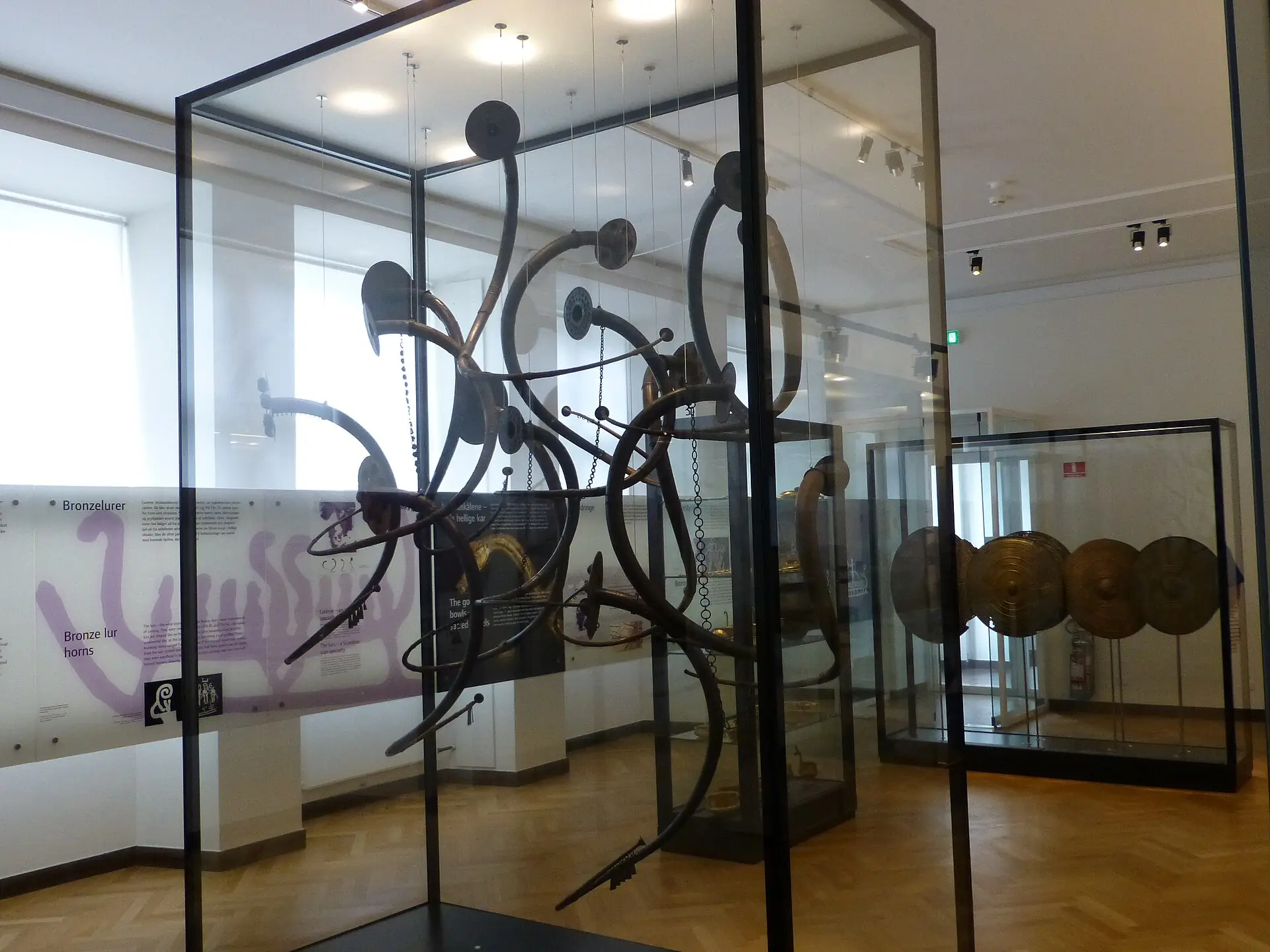
Late Bronze Age smiths cast great curved horns, most of them found in pairs in the bogs.
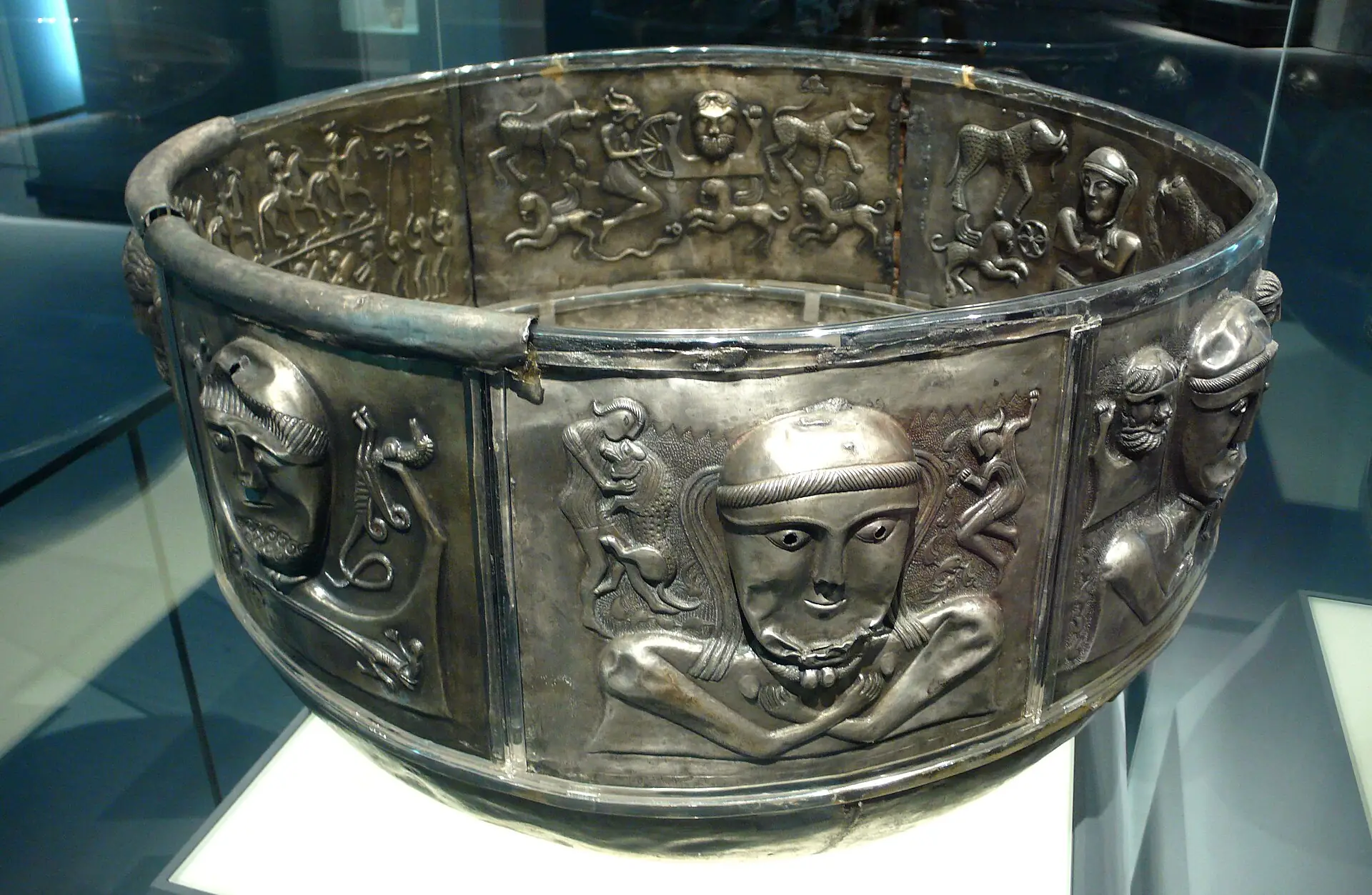
500 BCE – 792
Bog offerings, Roman silver and the first Danes.
Bog bodies such as the Tollund and Grauballe men, the Hjortspring boat and the Gundestrup cauldron belong to the Pre-Roman Iron Age, and the Cimbri and Teutones left Jutland to fight Rome. Roman contacts enriched chieftains at Himlingøje and Gudme, and great weapon sacrifices were made at Illerup Ådal and Nydam. The Danes are first named in the sixth century; royal halls at Lejre, the first Danevirke, the market town of Ribe and the Kanhave canal show an emerging kingdom.

The peaceful face of a man sacrificed in the fourth century BCE was preserved in a Jutland bog.

A great oak rowing ship was sunk in a sacred bog with the weapons of a defeated army.
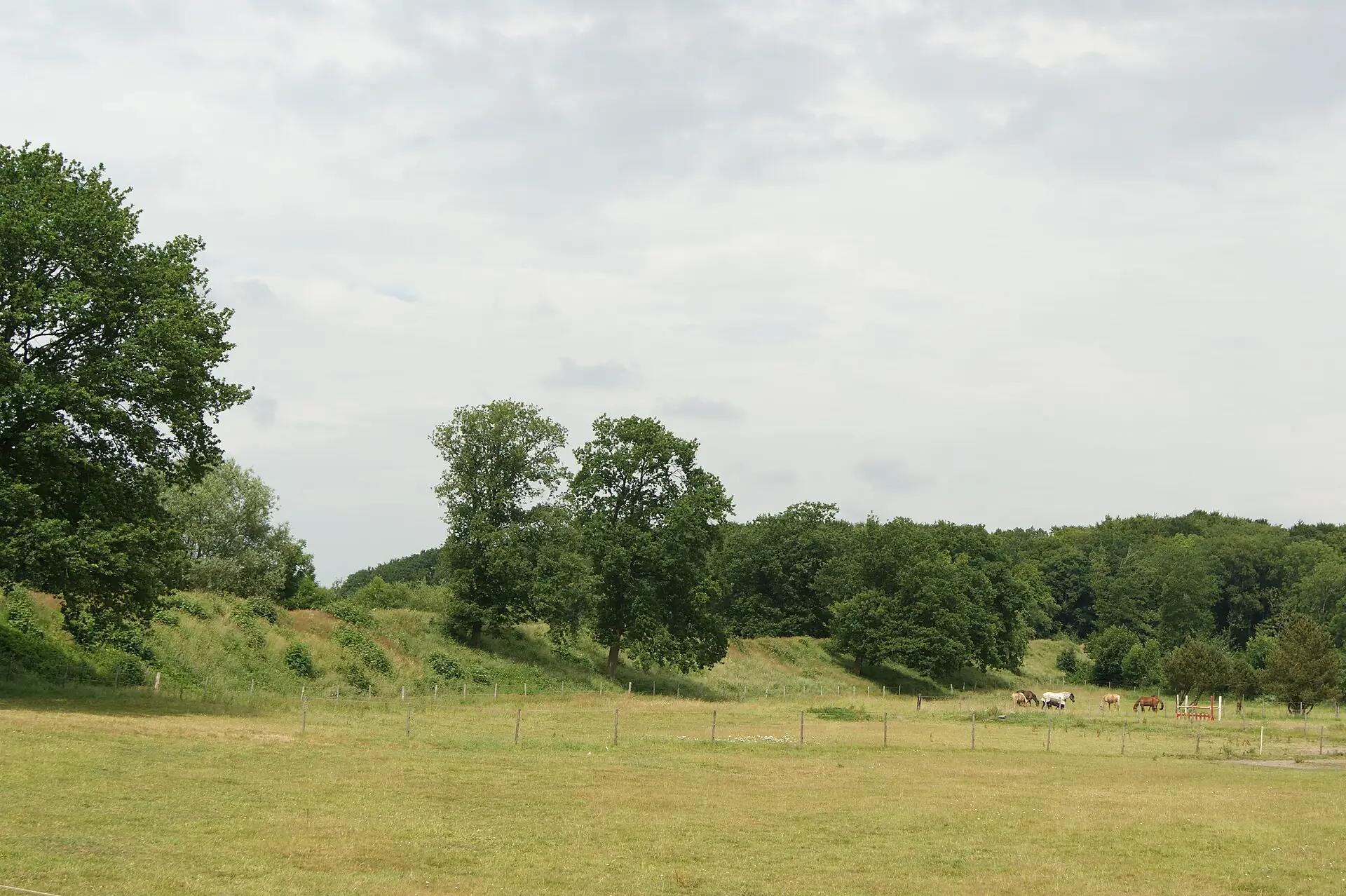
Around 500 the first ramparts were raised across the neck of Jutland.

Ribe grew up as a market place around 704–710 and is Scandinavia's oldest town.

793 – 1046
Raiders, traders and the making of a kingdom.
King Gudfred confronted Charlemagne and moved the merchants of Reric to Hedeby. Danish armies settled the Danelaw in England, and Rollo received Normandy. Gorm the Old and Harald Bluetooth united Denmark, which became Christian around 965, as the Jelling stones proclaim; Harald built the ring fortresses. Sweyn Forkbeard conquered England in 1013, and Cnut the Great ruled a North Sea Empire of England, Denmark and Norway.

The raid on the Northumbrian monastery in 793 opened the Viking Age.

King Gudfred moved the merchants of Reric to Hedeby, the great trading town of the Danes.

Harald Bluetooth built circular fortresses such as Trelleborg, Fyrkat and Aggersborg around 980.

Cnut the Great ruled England, Denmark and Norway after 1028.

1047 – 1339
Church, crown and a Baltic empire.
Sweyn II Estridsen founded the dynasty that ruled until 1412 and organised the church, and Lund became the archbishopric of the North. After the civil wars of 1131–1157 Valdemar I and Absalon began the Valdemarian era: the conquest of Rügen, the founding of Copenhagen and, under Valdemar II, Estonia and the legend of the Dannebrog, until defeat at Bornhöved in 1227. The Code of Jutland dates from 1241. Royal murders, the charter of 1282 and debt led to the kingless period of 1332–1340.

In 1103–1104 Lund became the church capital of all Scandinavia.

Bishop Absalon built a castle at the harbour of Havn in 1167, the beginning of the capital.

Saxo Grammaticus wrote the great Latin history of the Danes, with the tale of Amleth.

"With law shall the land be built": Valdemar II's code of 1241 was in force for over four centuries.

1340 – 1522
Three crowns under one monarch.
Valdemar IV Atterdag reunited the realm, sold Estonia and stormed Visby, but lost to the Hanseatic League. His daughter Margaret I united Denmark, Norway and Sweden in the Kalmar Union of 1397. Eric of Pomerania introduced the Sound Dues; Christian I founded the House of Oldenburg, became Duke of Schleswig and Count of Holstein and pledged Orkney and Shetland. The Stockholm Bloodbath of 1520 ended the union with Sweden.

Valdemar IV's knights crushed the Gotland peasant levy outside Visby in 1361.
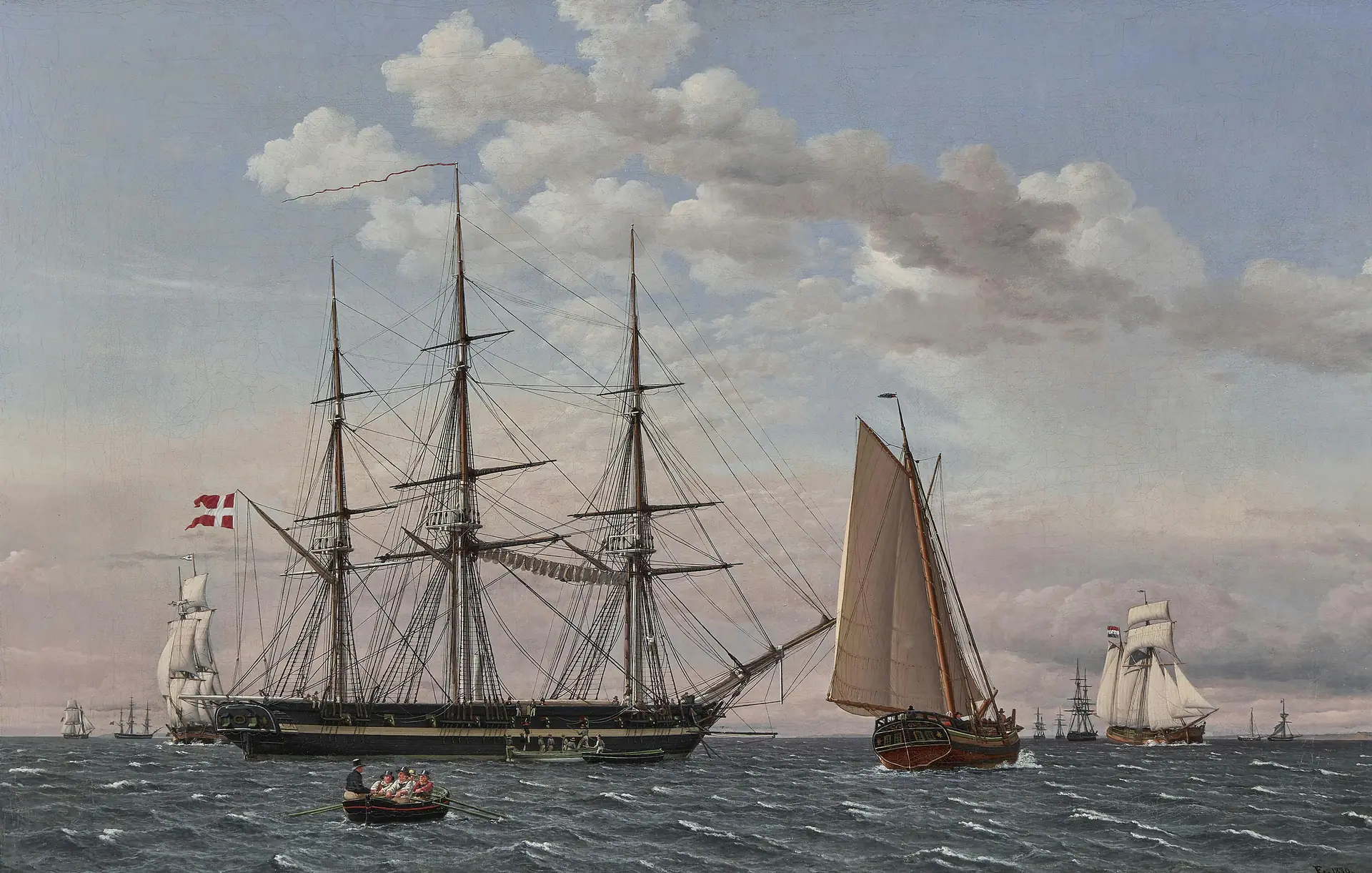
From 1429 every ship passing the Øresund paid a toll to the Danish king.

Denmark's first university opened in Copenhagen in 1479, after Queen Dorothea won the Pope's approval.

Mass executions after Christian II's coronation in 1520 turned Sweden against the union.

1523 – 1659
A Lutheran kingdom and its builder king.
The Count's Feud ended with Christian III's victory and the Lutheran Reformation of 1536, and Norway became a Danish province. Frederick II built Kronborg and supported Tycho Brahe. Christian IV founded towns and the colony of Tranquebar and built Rosenborg and the Round Tower, but lost the Thirty Years' War and the Torstenson War. The March Across the Belts led to the Treaty of Roskilde of 1658, which ceded Scania, Halland, Blekinge and Bohuslän for good.
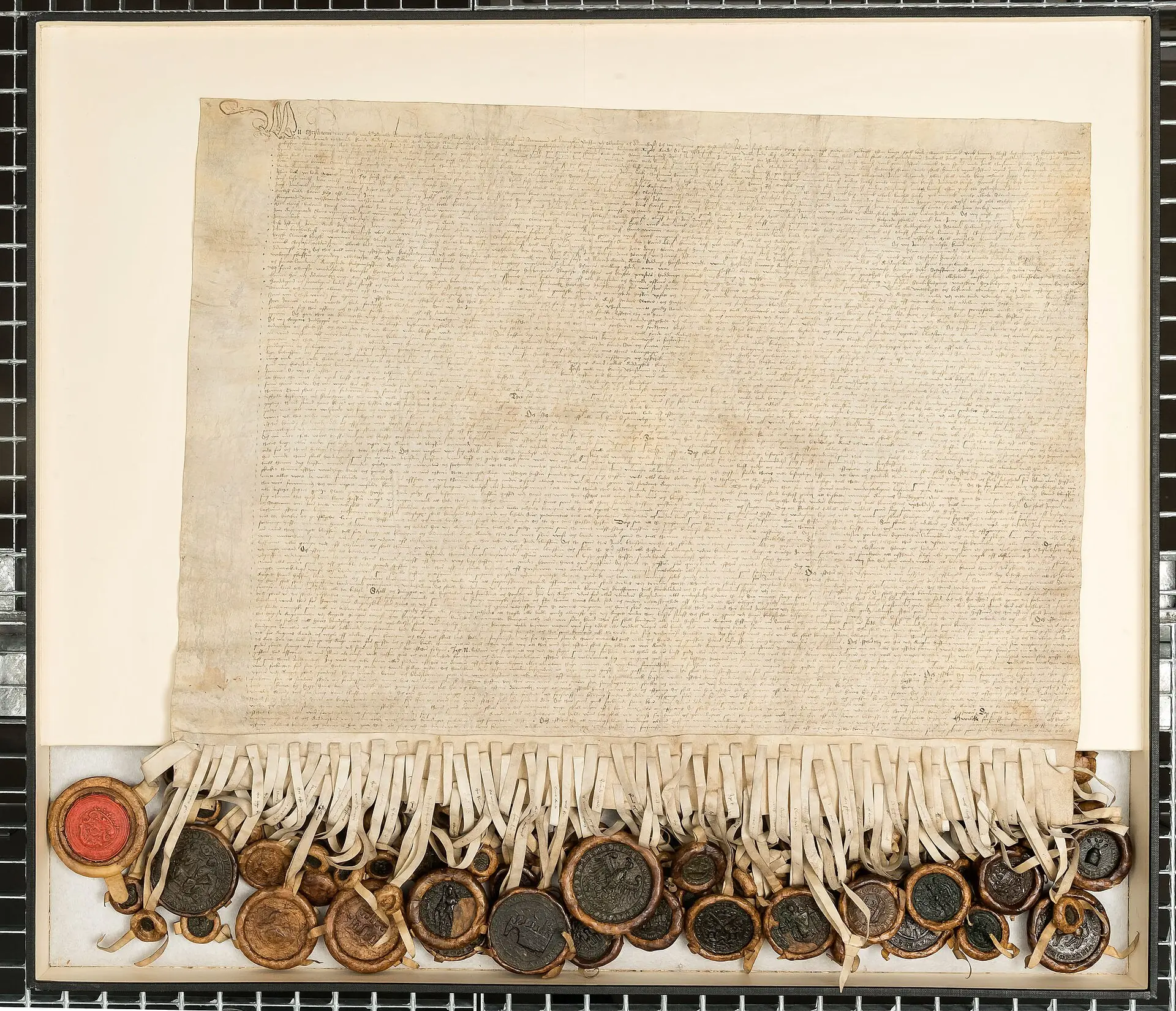
In 1536 Christian III deposed the Catholic bishops and made Denmark a Lutheran state.

On the island of Hven the astronomer built Uraniborg and measured the heavens.

Christian IV built an observatory with a spiral ramp in the heart of Copenhagen.

A Swedish army crossed the frozen Belts in 1658 and forced Denmark to cede Scania.

1660 – 1813
Absolute kings, colonies and reform.
Frederick III made the monarchy hereditary and absolute in 1660, confirmed by the Lex Regia. Danske Lov, colonies in the Caribbean, on the Gold Coast and in India, and Hans Egede's Greenland mission followed. Struensee's reforms, the agrarian reforms and the abolition of the stavnsbånd, and the decree against the slave trade marked the late eighteenth century. British attacks in 1801 and 1807 drew Denmark to Napoleon's side, and the state went bankrupt in 1813.

Ole Rømer showed in 1676 that light travels at a finite speed.

Settlers took St Thomas in 1672, the start of a plantation colony worked by enslaved Africans.

The agrarian reforms of 1788 ended the stavnsbånd that bound peasants to their estates.

In 1807 British guns set Copenhagen ablaze and Britain carried off the Danish fleet.

1814 – 1864
A golden age, a constitution and a lost war.
The Treaty of Kiel cost Denmark Norway in 1814. A Golden Age of culture followed, with Ørsted, Andersen, Kierkegaard, Thorvaldsen and Grundtvig. Absolutism ended in March 1848, and the June Constitution of 1849 made Denmark a constitutional monarchy. The First Schleswig War was won, but the November Constitution provoked the Second Schleswig War of 1864, with defeat at Dybbøl and the loss of Schleswig, Holstein and Lauenburg.

In 1820 Hans Christian Ørsted saw an electric current move a compass needle.

Hans Christian Andersen published his first fairy tales, The Tinderbox among them, in 1835.

Either/Or, published in 1843, became a founding work of existentialism.
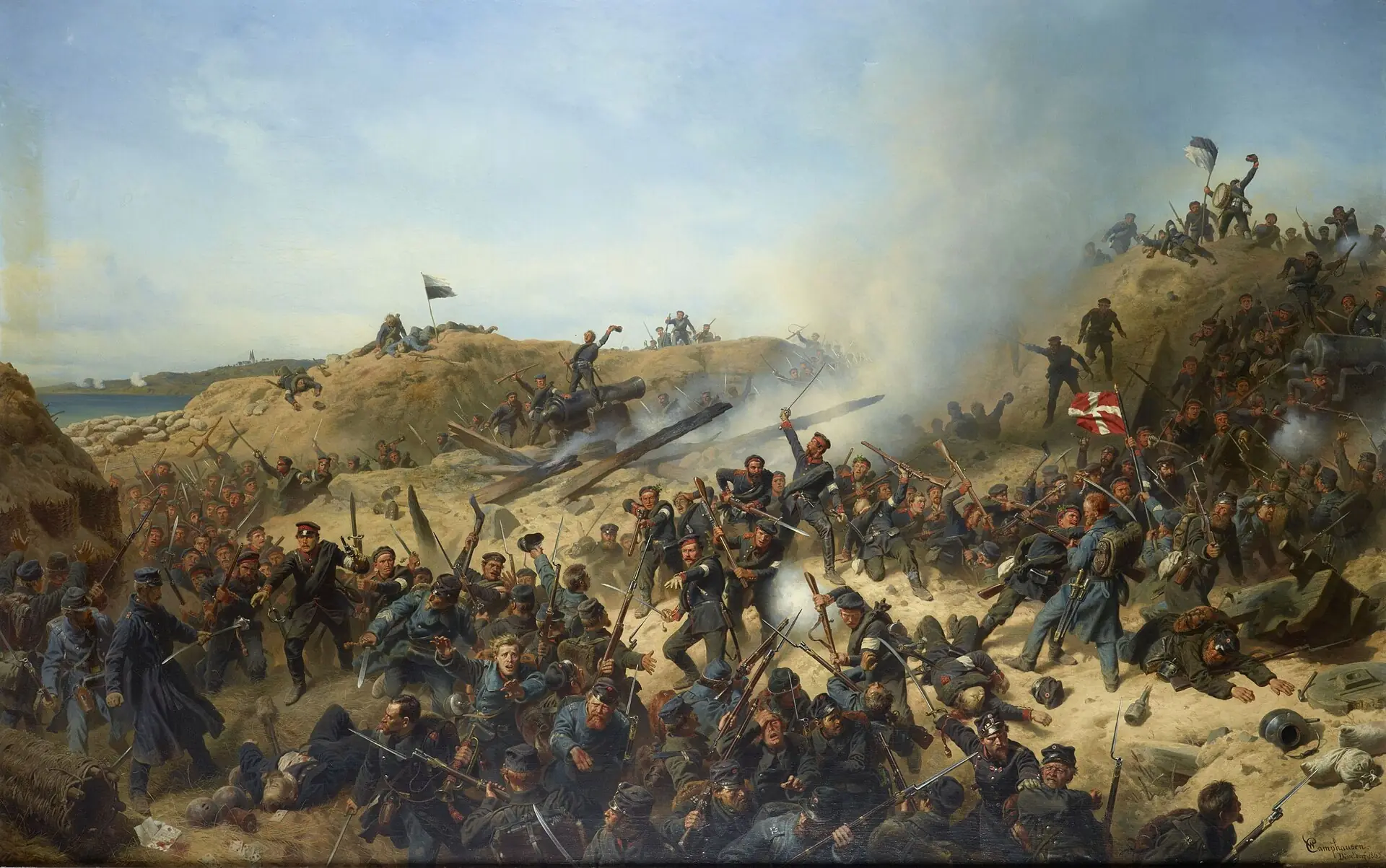
Prussian troops stormed the Dybbøl redoubts on 18 April 1864.

1865 – 1945
Cooperation, democracy and occupation.
Heath reclamation, cooperative dairies, folk high schools and the labour movement shaped a smaller nation; parliamentarism came in 1901 and women's suffrage in 1915. The Danish West Indies were sold to the United States, Iceland became a separate kingdom and North Schleswig returned in 1920. Stauning's Social Democrats laid the foundations of the welfare state. Germany occupied Denmark from 1940 to 1945; the cooperation policy collapsed in August 1943, and most Danish Jews were rescued to Sweden.

From 1882 farmers pooled their milk in cooperative dairies and made butter and bacon for Britain.

The constitution of 1915 gave women the right to vote and stand for parliament.

After the plebiscites of 1920 North Schleswig returned to Denmark.

Bohr's institute made Copenhagen a capital of quantum physics.
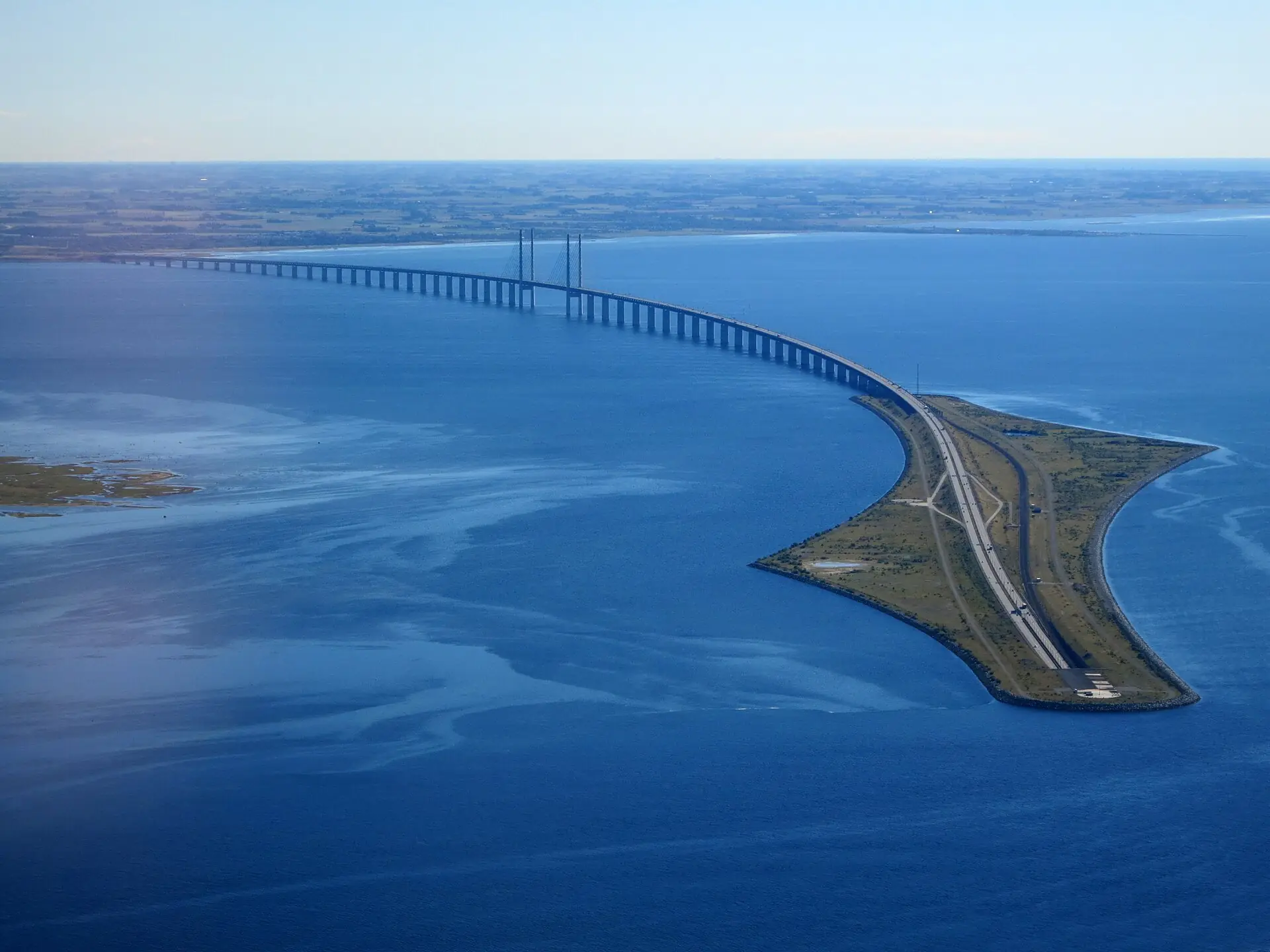
1946 – present
Welfare, Europe and the Danish Realm.
Denmark joined NATO in 1949 and the European Community in 1973, and the Faroe Islands and Greenland gained home rule and self-government. The 1953 constitution allowed a woman to inherit the throne, and Margrethe II reigned from 1972 until she abdicated in favour of Frederik X in 2024. The welfare state, the referendums on Europe, immigration policy, the Muhammad cartoons crisis, US pressure over Greenland and Mette Frederiksen's governments shape the Denmark of today.

Denmark gave up neutrality and became a founding member of NATO in 1949.

Jørn Utzon won the competition in 1957 with a design of shell-like roofs.

Greenland gained home rule in 1979 and self-government in 2009.

Margrethe II abdicated after 52 years, and Frederik X was proclaimed king in January 2024.
From the Ice Age to the Danish Realm, c. 12,500 BCE – Today
From reindeer hunters at the edge of the ice to Cnut’s North Sea Empire, the Kalmar Union, Denmark–Norway and its colonies, and today’s Kingdom of Denmark with the Faroe Islands and Greenland. Move to any year, or through 38 narrated chapters.
Move the slider to any year: every polity recorded for that year is drawn. Danish lands are coloured by their status — the kingdom itself, unions under the Danish crown, colonies and North Atlantic dependencies, Danish settlement abroad, the personal union with Iceland and the occupation of 1940–45 — and all other states are grey. 38 chapters carry the story. Borders change only where the dataset records a change, and they fade rather than morph between dated polygons. The slider gives each era its own share, so that 14,000 years of prehistory do not crowd out recorded history. Hover a territory for its name and dates; click it to open its Wikipedia article. Small colonies and historic centres are marked with points.
Borders before 936 show the Danish lands (Jutland, the islands, Scania and Schleswig to the Eider) rather than a state. Medieval and early modern borders are approximate and follow Cliopatria’s choices; unions such as the Kalmar Union and Denmark–Norway are drawn as one realm. “Modern outline” shows today’s Denmark as a dashed line for orientation.
If the page stays blank, the site doesn't allow embedding — use “Open in new tab”.
From the reindeer hunters at the edge of the ice to the modern welfare state, the history of Denmark has given the world the Viking Age and its runestones, one of the oldest monarchies in the world, landmarks of science from Tycho Brahe to Niels Bohr, the fairy tales of Andersen and the philosophy of Kierkegaard, folk high schools and cooperatives, a tradition of consensus and welfare, and a realm that still reaches from the Baltic to the Arctic.
Danish Vikings raided the Frankish empire, settled the Danelaw and ruled England under Sweyn Forkbeard and Cnut the Great. At Jelling, Harald Bluetooth's runestone records how he "won all of Denmark and Norway and made the Danes Christian"; it is often called Denmark's birth certificate. The Jelling monuments, Hedeby and the Danevirke, and the ring fortresses are UNESCO World Heritage Sites.
The Code of Jutland of 1241 opens with the words "With law shall the land be built", which still stand above the Copenhagen Court House, and Christian V's Danish Law of 1683 gave the kingdom a single code. The Reformation of 1536 made Denmark a Lutheran state; the Christian III Bible of 1550 helped standardise written Danish, and missions went to Tranquebar, the first Protestant mission in India, and to Greenland.
Tycho Brahe's new star of 1572 challenged ancient astronomy, and the observations he made at Uraniborg on Hven later allowed Kepler to formulate the laws of planetary motion. Nicolas Steno founded modern geology, Ole Rømer showed that light travels at a finite speed, and Hans Christian Ørsted discovered electromagnetism in 1820. Niels Bohr's institute made Copenhagen a capital of quantum physics, and Bohr won the Nobel Prize in 1922.
In the early nineteenth century a small and impoverished state produced a flowering of art and thought. Hans Christian Andersen's fairy tales went round the world, Søren Kierkegaard's Either/Or became a founding work of existentialism, and Bertel Thorvaldsen was one of Europe's leading neoclassical sculptors. Oehlenschläger's poetry and the painters taught by Eckersberg at the Academy of Fine Arts gave the age its voice and its images.
N. F. S. Grundtvig's idea of a "school for life" inspired the first folk high school at Rødding in 1844 and, after 1864, Askov and many more, where young farmers studied history, literature and song. From the dairy at Hjedding in 1882 the cooperative movement, with one vote per member, spread to over a thousand dairies and to bacon factories, and turned Danish farming to butter and bacon for Britain.
The June Constitution of 1849 made Denmark a constitutional monarchy, and women won the vote in 1915. The September Compromise of 1899 founded a labour market governed by agreements between employers and unions, and from the Kanslergade Agreement of 1933 to the universal pension of 1956 Denmark built a tax-financed welfare state. In October 1943 ordinary Danes carried some 7,200 of the country's 7,800 Jews to safety in Sweden.
Denmark–Norway held forts on the Gold Coast, trading posts in India and the Caribbean islands of St Thomas, St John and St Croix, whose plantations depended on enslaved Africans. Denmark decreed an end to its slave trade in 1792, but slavery in the islands lasted until 1848. Greenland and the Faroe Islands remain self-governing parts of the Danish Realm, and Denmark's 2025 apology to Greenlandic women is part of a continuing reckoning with that past.
Danish kings built for display, from Kronborg, the Elsinore of Shakespeare's Hamlet, and Rosenborg to the Round Tower and the rococo district of Frederiksstaden. In the twentieth century "Danish modern" furniture by Wegner, Juhl and Arne Jacobsen joined craftsmanship to clean, functional forms; Jørn Utzon's Sydney Opera House became one of the world's most recognisable buildings, and the LEGO brick from Billund an emblem of Danish design.
The timeline is built from the project's own research dossier and its event, ruler, prime minister and map datasets, checked against English Wikipedia, Encyclopaedia Britannica, Den Store Danske (lex.dk), the National Museum of Denmark and other references. Linked articles are starting points for verification, not proof that every claim has been independently checked. Prehistoric and early medieval dates are archaeological or dendrochronological estimates and dates marked "c." are approximate; kings before Gorm the Old are known only from Frankish sources, and the Skjöldung kings of Lejre are legendary. Casualty and rescue figures are published estimates. The most recent events, from 2025 and 2026, rest on sources that are still changing; historical borders are reconstructions.
Every event and every ruler has its own sources. See Sources & Further Reading in each timeline entry and ruler profile.
History is connected. Explore the bigger picture.
AllHistories is an independent visual history project designed to make the past easier to understand, explore, and connect.
History is more than a collection of dates, rulers, and battles. Events rarely happen in isolation. Borders shift, civilizations influence one another, ideas spread, and decisions made centuries ago continue to shape the world today.
Through interactive timelines, historical maps, and visual storytelling, AllHistories helps uncover these connections and makes complex historical subjects more accessible and engaging.
Travel through centuries, discover turning points, and understand how historical events unfold and connect.
Explore how borders, civilizations, populations, trade routes, beliefs, and spheres of influence have changed over time.
Go beyond dates and discover the individuals, places, decisions, and circumstances behind historical developments.
Explore connections between countries, empires, civilizations, and historical themes to better understand cause and consequence.
Features vary depending on the historical subject.
AllHistories draws on historical research, published references, public archives, and available historical datasets. The information is organized and presented through interactive digital experiences.
History is not always certain or universally agreed upon. Dates, territorial boundaries, population figures, and interpretations may differ between sources. Some information is necessarily simplified or estimated for visual presentation.
The goal is to encourage curiosity and independent exploration, not to replace academic publications or specialist historical research.
When you visit AllHistories, the web server may process technical information such as your IP address, requested pages, browser details and access times to deliver pages and maintain the service.
Some pages load Google Analytics, Google Fonts, externally hosted images, maps or other third-party resources. Requests to these providers can transmit technical information, including your IP address. Contact forms may use Google reCAPTCHA to help prevent abuse. These providers apply their own privacy policies.
The website uses browser storage for preferences such as the selected theme. Country microsites also use a session cookie to support website functionality, including request protection. Analytics or other third-party services may use additional cookies or storage, depending on the page and your browser settings.
When you submit a correction or contact form, the information you provide, such as your name, email address and message, is processed to review and respond to your request. Please avoid including sensitive personal information.
You can manage cookies and site storage in your browser and control third-party requests through browser privacy settings. For privacy questions or requests concerning information you submitted, use the contact option on the microsite where you sent it.
Links to sources and other websites take you to services with their own privacy practices. Review their policies before providing personal information.
AllHistories provides historical information for general education and exploration. Its content is not professional, legal, financial or other specialist advice.
We aim to present useful, well-sourced summaries, but cannot guarantee that every date, statement, translation or interpretation is complete or accurate. Verify important claims against the cited sources and relevant scholarship. Content may be corrected or updated.
Maps are simplified historical illustrations. Borders, place names and territorial labels may vary by period and source. Their appearance does not express a position on sovereignty or present-day territorial disputes.
Images and source material may belong to their respective creators or rights holders. Consult the image credit, source page and license before reusing material. A link or credit does not grant additional reuse rights.
External links are provided for reference. AllHistories does not control the content, availability or policies of third-party websites.
To report an error or a concern about credited material, use the contact option on the relevant country microsite and identify the page, material and supporting details.