Key facts of the era
Key Events
Journey through the people, battles and ideas that shaped the Dominican Republic, from the first islanders of Hispaniola to the republic of today.
Follow the Taíno cacicazgos, Columbus and the first city of the Americas, Spanish, French and Haitian rule, independence in 1844, the US occupation and the Trujillo years.
Explore 10 historical periods, the sovereigns, governors and presidents, and 18 chapters of territorial change.
Taíno caciques, Spanish and French sovereigns, colonial governors and captains-general, Haitian and US rulers, and the presidents of the Dominican Republic.
A Journey Through the Ages
The Dominican Republic: the five Taíno cacicazgos of Hispaniola, Columbus and Santo Domingo, the Spanish colony, French and Haitian rule, independence in 1844, the US occupation and the Trujillo dictatorship, through to the contemporary republic.

4,000 BCE – 1491
Five chiefdoms under their caciques
Archaic hunter-gatherers reached Hispaniola around 4000 BC; Saladoid and Ostionoid farmers followed, and by the 15th century the Taíno lived in five large chiefdoms (cacicazgos) under their caciques, with villages, ball courts, zemis and cave art.
1492 – 1585
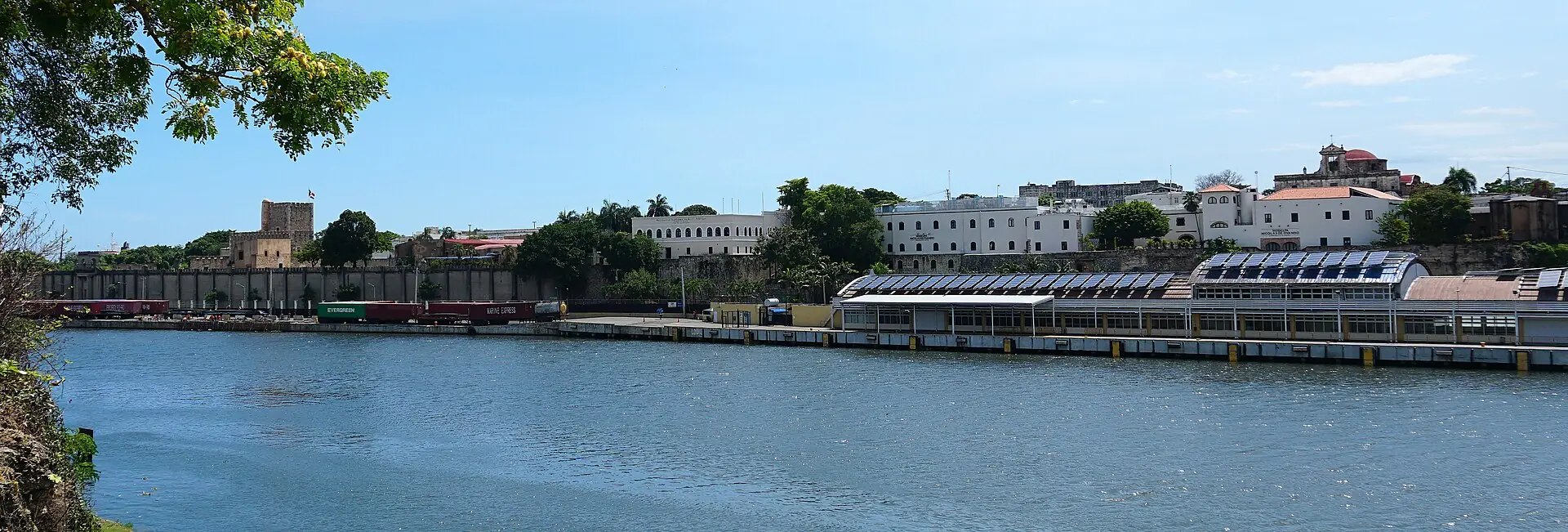
The first city of the Americas
Columbus's landing (1492), La Isabela and Santo Domingo, the conquest and collapse of the Taíno, the encomienda, gold and then sugar and African slavery, Enriquillo's revolt, and the first cathedral, university and Audiencia of the Americas.

1586 – 1794
Depopulation, contraband and two colonies
Drake's sack (1586), the Devastations of Osorio (1605–06), buccaneers and the French colony of Saint-Domingue in the west, the treaties of Ryswick (1697) and Aranjuez (1777), Canary Islander settlers, cattle ranching and privateering.

1795 – 1843
France, Spain and Haiti
The Peace of Basel cedes Santo Domingo to France (1795); Toussaint Louverture, French rule under Ferrand, the Spanish reconquest (1809) and the España Boba, the Ephemeral Independence of 1821 and Haitian rule over the whole island (1822–44), and Duarte's Trinitaria.
1844 – 1865
Independence, annexation and restoration
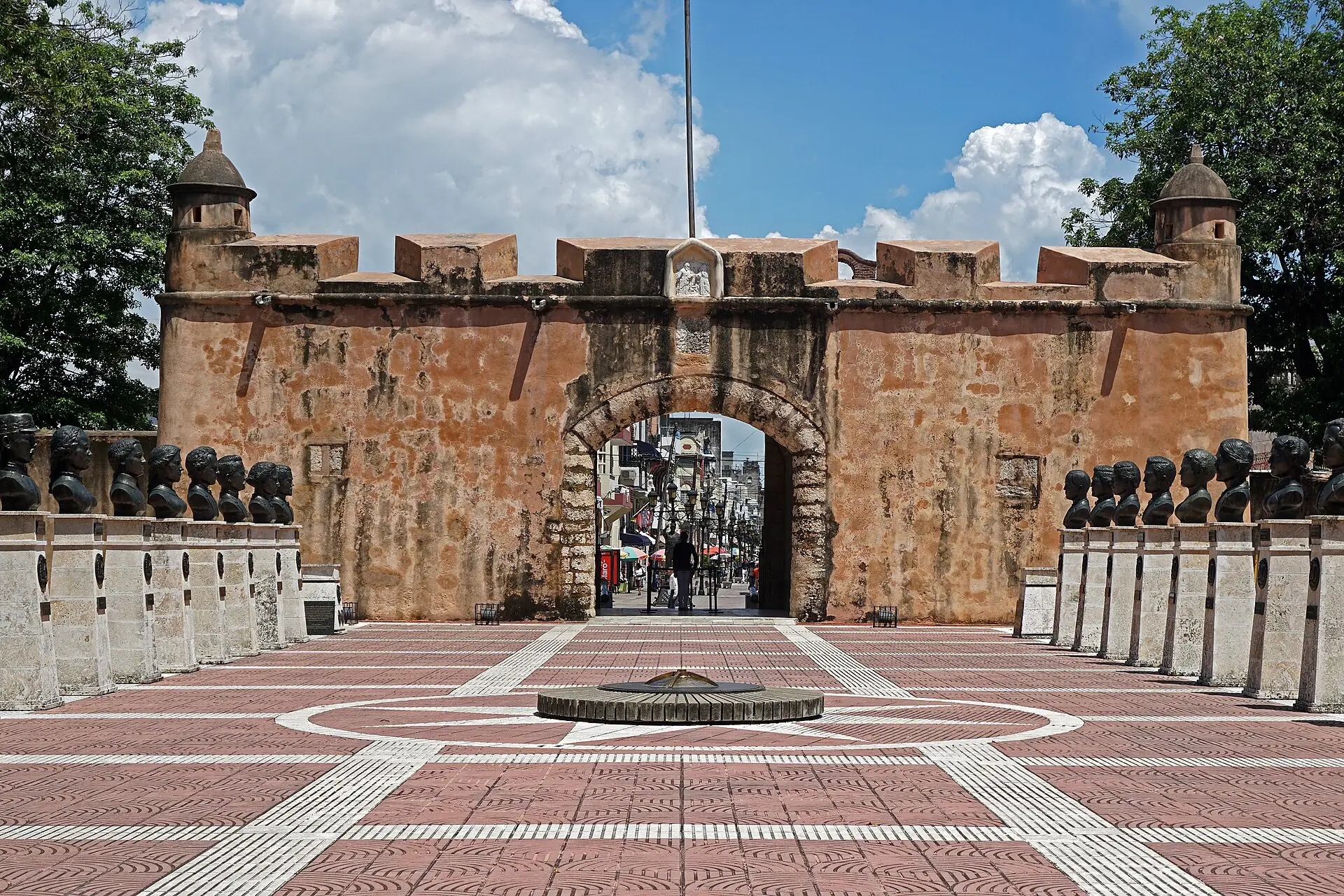
Independence on 27 February 1844, the wars with Haiti, the rivalry of Pedro Santana and Buenaventura Báez, annexation to Spain (1861) and the Restoration War that restored the republic in 1865.

1866 – 1915
Caudillos, debt and receivership
Blues and Reds, Báez's Six Years and the failed US annexation treaty, the sugar boom, Ulises Heureaux's dictatorship (1882–99), debt, the US customs receivership (1905) and the instability that led to occupation.
1916 – 1929
A military government
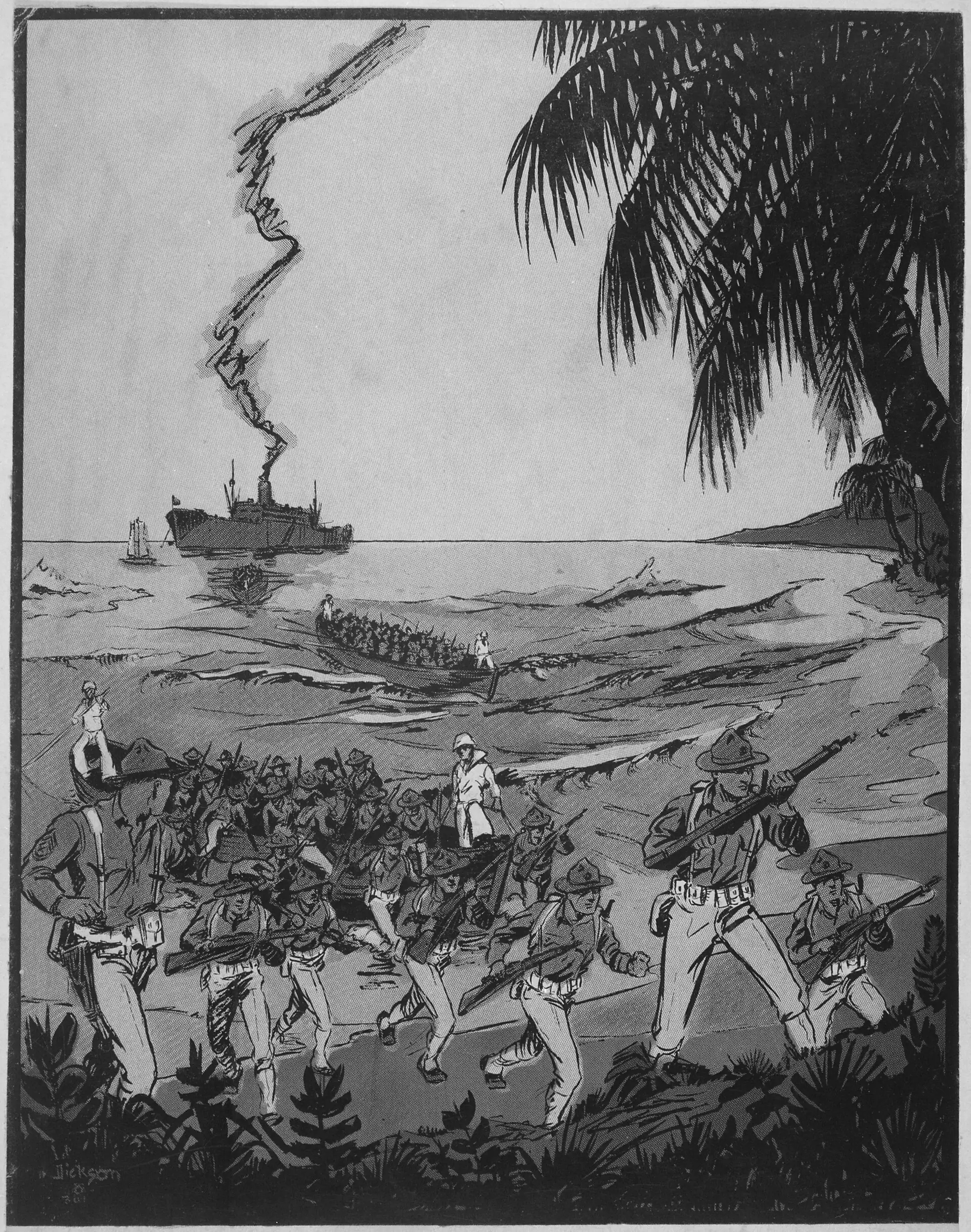
US marines land in 1916 and a military government rules until 1924; the gavilleros resist in the east, the Guardia Nacional is created, and Horacio Vásquez governs after the withdrawal.

1930 – 1961
The Trujillo dictatorship
Rafael Leónidas Trujillo's 31-year dictatorship: Ciudad Trujillo, the Parsley massacre (1937), the end of the receivership, Sosúa, the 1959 invasions, the murder of the Mirabal sisters and Trujillo's assassination on 30 May 1961.

1962 – 1995
Civil war and the Twelve Years
The Council of State, Juan Bosch's short presidency (1963), the civil war and US intervention of 1965, Joaquín Balaguer's Twelve Years, the PRD governments of 1978–86 and Balaguer's return to 1996.

1996 – present
Democracy, tourism and the border
PLD and PRD/PRM governments under Leonel Fernández, Hipólito Mejía, Danilo Medina and Luis Abinader: growth, tourism and free-trade zones, the 2003 banking crisis, the 2010 Constitution, Haitian migration and the border, and the Jet Set tragedy of 2025.
Taíno, Spain, France, Haiti and the Republic – Prehistory to Today
From the Taíno cacicazgos and Columbus’s Santo Domingo to French Saint-Domingue, Haitian rule, independence in 1844, annexation and Restoration, the US occupation, Trujillo, the civil war of 1965 and the contemporary republic.
If the page stays blank, the site doesn't allow embedding — use “Open in new tab”.
Santo Domingo, founded in 1496 and moved to the west bank of the Ozama in 1502, was the seat of the first Audiencia, cathedral and university in the Americas and the base from which Puerto Rico, Cuba and later the mainland were conquered. Its Colonial City was named a UNESCO World Heritage Site in 1990.
The Dominican Republic proclaimed itself on 27 February 1844 by breaking away from Haitian rule, then gave itself back to Spain in 1861 and restored the republic in the Restoration War of 1863–65. Duarte, Sánchez and Mella, the founders of La Trinitaria, remain its foundational heroes, and the relationship with Haiti, from the 1937 Parsley massacre to today’s border and migration disputes, is still central to Dominican politics and identity.
The debts and civil wars of the nineteenth-century caudillos led to the US customs receivership of 1905 and the American occupation of 1916–24. Rafael Trujillo then ruled for thirty-one years until his assassination on 30 May 1961, and the civil war and US intervention of 1965 opened the way to Joaquín Balaguer’s Twelve Years and, from 1978, to the peaceful alternation of parties in power.
Merengue and bachata, both recognised by UNESCO as intangible heritage, baseball that has sent generations of Dominican players to the major leagues, free-trade zones and tourism shape the modern republic. With about 10.8 million people in the 2025 projection, it faces continuing questions about migration, corruption and the border with Haiti.
Events, ruler profiles and facts retain the references supplied with the dataset, mostly English Wikipedia with Encyclopaedia Britannica and national sources. A separate fact-check covered about 92 events, all 124 presidential entries, the US military governors, 15 colonial governors and 24 facts; structural and display checks do not establish historical accuracy. Colonial governors follow the Spanish Wikipedia list where it is more detailed than the English one, and rival authorities (the Cibao government of 1857–58, the Restoration governments of 1863–65 and the governments of the 1965 civil war) are kept and flagged as disputed.
Estimates of the Taíno population in 1492 range from tens of thousands to over a million. The founding of Santo Domingo is dated 1496 or 1498, and several sixteenth- and seventeenth-century governors’ dates differ between sources. The death toll of the 1937 Parsley massacre is estimated at between about 14,000 and 40,000. Events of 2024–2026 were checked in October 2026 and may be revised as reporting develops.
The map shades the 32 Dominican provinces and the 10 Haitian departments of Hispaniola (Natural Earth boundaries, simplified) according to the power that controlled each, with lighter shading for partial, nominal, contested or occupied control. The five Taíno cacicazgos are assigned to present-day units approximately, following the chroniclers’ descriptions. It is an indicative overview, not a reconstruction of exact historical borders.
Population figures combine an estimate for the Taíno in 1508, colonial estimates for about 1790 and 1809, the national censuses of 1920 to 2022 and the 2025 national projection; no reliable figure is attributed for the years between, so the map badge hides them. Event images and portraits are pending; this microsite uses a gradient and a generic ruler placeholder.
History is connected. Explore the bigger picture.
AllHistories is an independent visual history project designed to make the past easier to understand, explore, and connect.
History is more than a collection of dates, rulers, and battles. Events rarely happen in isolation. Borders shift, civilizations influence one another, ideas spread, and decisions made centuries ago continue to shape the world today.
Through interactive timelines, historical maps, and visual storytelling, AllHistories helps uncover these connections and makes complex historical subjects more accessible and engaging.
Travel through centuries, discover turning points, and understand how historical events unfold and connect.
Explore how borders, civilizations, populations, trade routes, beliefs, and spheres of influence have changed over time.
Go beyond dates and discover the individuals, places, decisions, and circumstances behind historical developments.
Explore connections between countries, empires, civilizations, and historical themes to better understand cause and consequence.
Features vary depending on the historical subject.
AllHistories draws on historical research, published references, public archives, and available historical datasets. The information is organized and presented through interactive digital experiences.
History is not always certain or universally agreed upon. Dates, territorial boundaries, population figures, and interpretations may differ between sources. Some information is necessarily simplified or estimated for visual presentation.
The goal is to encourage curiosity and independent exploration, not to replace academic publications or specialist historical research.
When you visit AllHistories, the web server may process technical information such as your IP address, requested pages, browser details and access times to deliver pages and maintain the service.
Some pages load Google Analytics, Google Fonts, externally hosted images, maps or other third-party resources. Requests to these providers can transmit technical information, including your IP address. Contact forms may use Google reCAPTCHA to help prevent abuse. These providers apply their own privacy policies.
The website uses browser storage for preferences such as the selected theme. Country microsites also use a session cookie to support website functionality, including request protection. Analytics or other third-party services may use additional cookies or storage, depending on the page and your browser settings.
When you submit a correction or contact form, the information you provide, such as your name, email address and message, is processed to review and respond to your request. Please avoid including sensitive personal information.
You can manage cookies and site storage in your browser and control third-party requests through browser privacy settings. For privacy questions or requests concerning information you submitted, use the contact option on the microsite where you sent it.
Links to sources and other websites take you to services with their own privacy practices. Review their policies before providing personal information.
AllHistories provides historical information for general education and exploration. Its content is not professional, legal, financial or other specialist advice.
We aim to present useful, well-sourced summaries, but cannot guarantee that every date, statement, translation or interpretation is complete or accurate. Verify important claims against the cited sources and relevant scholarship. Content may be corrected or updated.
Maps are simplified historical illustrations. Borders, place names and territorial labels may vary by period and source. Their appearance does not express a position on sovereignty or present-day territorial disputes.
Images and source material may belong to their respective creators or rights holders. Consult the image credit, source page and license before reusing material. A link or credit does not grant additional reuse rights.
External links are provided for reference. AllHistories does not control the content, availability or policies of third-party websites.
To report an error or a concern about credited material, use the contact option on the relevant country microsite and identify the page, material and supporting details.
Heritage · c. 4000 BC
Did you know that the first humans reached the Caribbean islands, Hispaniola included, around 6,000 years ago as hunter-gatherers who most likely crossed by canoe from Central America or northern South America, thousands of years before the Taíno arrived?
Culture · from c. 2,000 years ago
Did you know that the Pomier Caves north of San Cristóbal hold about 6,000 drawings, carvings and pictographs, drawn with charcoal mixed with animal fat over some 2,000 years, making them the largest collection of rock art in the Caribbean?
Heritage · c. 600
Did you know that the Ostionoid farmers who were the direct ancestors of the Taíno spread across Hispaniola only around AD 600, the last stage of a slow island-hopping migration of ceramic-making peoples from South America that had begun centuries earlier?
Language · before 1492
Did you know that the Taíno called the eastern part of Hispaniola Quisqueya, 'mother of all lands', and the word survives in the opening line of the Dominican national anthem, 'Quisqueyanos valientes' (Valiant Quisqueyans)?
Firsts · 6 January 1494
Did you know that La Isabela, founded by Columbus on the north coast of today's Puerto Plata province around New Year 1494, was the first stable Spanish town in the Americas, yet hunger, disease and hurricanes had emptied it by 1500?
Records · 1496
Did you know that Santo Domingo, founded by Christopher Columbus's brother Bartholomew in 1496 and first named La Nueva Isabela, is the oldest continuously inhabited European settlement anywhere in the Americas?
Firsts · 1503
Did you know that the roofless ruins of the Hospital San Nicolás de Bari in Santo Domingo, begun in 1503 on the orders of governor Nicolás de Ovando, are recognised by UNESCO as the oldest hospital built in the Americas?
Society · 21 December 1511
Did you know that on 21 December 1511 the Dominican friar Antonio de Montesinos preached a sermon in Santo Domingo condemning the encomienda system, making him the first European to publicly denounce the enslavement and mistreatment of the island's indigenous people?
Society · 25 December 1521
Did you know that the first major slave revolt in the Americas broke out on Christmas Day 1521 on the sugar estate of Diego Colón, Columbus's son, led by enslaved Muslim Wolof who then fled to form maroon communities in the mountains?
Heritage · 1519–1533
Did you know that the Taíno cacique Enriquillo held out against the Spanish in the Bahoruco mountains from 1519 to 1533 until a treaty granted his people freedom, and the Caribbean's largest lake is now named after him?
Firsts · 1538
Did you know that the Universidad Santo Tomás de Aquino in Santo Domingo, authorised by a papal bull in 1538, was one of the first universities in the Americas, and today's Autonomous University of Santo Domingo claims it as its ancestor?
Records · 31 August 1541
Did you know that Santo Domingo's coral-limestone Cathedral of Santa María la Menor, consecrated on 31 August 1541, is the oldest existing cathedral in the Americas, and its archbishop still holds the honorary title of Primate of the Indies?
Economy · January 1586
Did you know that Sir Francis Drake occupied Santo Domingo for exactly a month in 1586, burning buildings one after another until the Spanish agreed to pay a ransom of 25,000 ducats, after first demanding one million?
Society · 1605–1606
Did you know that in 1605–1606 Governor Antonio de Osorio forcibly depopulated the north and west of Hispaniola to stop smuggling, razing towns such as Puerto Plata and Montecristi and opening the way for the French colony of Saint-Domingue?
Language · 17th century
Did you know that the word buccaneer comes from buccan, the wooden frame on which Taíno and Caribs smoked meat, adopted by French hunters of feral cattle and pigs on the empty western half of Hispaniola, the boucaniers?
Myth or fact · 1655
Did you know that Oliver Cromwell's 1655 expedition was really aimed at Santo Domingo, and only after the English were repulsed from the city did they sail on and seize Jamaica instead?
Geography · 22 July 1795
Did you know that in the 1795 Peace of Basel Spain handed its entire colony of Santo Domingo to revolutionary France in exchange for keeping the Basque province of Gipuzkoa, which French troops had occupied?
Society · January 1801
Did you know that in 1801 Toussaint Louverture marched into Spanish-speaking Santo Domingo, brought it under French law and abolished slavery, bringing the whole of Hispaniola under his control?
Records · 1 December 1821
Did you know that the Dominicans' first independence from Spain, declared by José Núñez de Cáceres on 1 December 1821 as the Republic of Spanish Haiti, lasted only until 9 February 1822, when Haiti annexed it?
Language · 1824
Did you know that the Samaná Peninsula is home to about 8,000 Samaná Americans, descendants of free African Americans who emigrated from 1824 at the invitation of Haitian president Jean-Pierre Boyer and still keep a dialect called Samaná English?
Society · 16 July 1838
Did you know that La Trinitaria, the secret society founded by Juan Pablo Duarte on 16 July 1838 to free the country from Haitian rule, worked in three-person cells and communicated through passwords and codes?
Myth or fact · 27 February 1844
Did you know that the Dominican Republic's Independence Day, 27 February, marks not a break with Spain but the 1844 seizure of Santo Domingo's Puerta del Conde from Haiti, which had ruled the whole island for 22 years?
Heritage · 1844
Did you know that the first Dominican flags were sewn by four women, María Trinidad Sánchez, María de Jesús Pina, Isabel Sosa and Concepción Bona, for the independence movement of 1844?
Records · 18 March 1861
Did you know that in 1861 President Pedro Santana voluntarily handed the Dominican Republic back to Spain, a voluntary annexation that briefly boosted Spain's image as a reviving great power until its troops withdrew in 1865?
Society · 16 August 1863
Did you know that Dominican presidents are sworn in every four years on 16 August, the anniversary of the 1863 Grito de Capotillo near Dajabón that launched the Restoration War against Spanish rule?
Records · 30 June 1870
Did you know that President Ulysses S. Grant's treaty to annex the Dominican Republic to the United States died in the US Senate on 30 June 1870 on a tie vote, far short of the two-thirds needed?
Society · 1871
Did you know that the abolitionist Frederick Douglass accompanied the US commission Grant sent to Santo Domingo in 1871 to investigate annexation, and that Douglass actually supported the plan, hoping it would bring the island stability?
Heritage · 15 July 1876
Did you know that Juan Pablo Duarte, the Father of the Dominican Nation, spent most of his life after independence in exile in Venezuela, including years in the Amazon jungle, and died in Caracas in 1876?
Myth or fact · 1877
Did you know that in 1877 a priest found a lead box in Santo Domingo's cathedral inscribed 'Discoverer of America, First Admiral', so both Seville Cathedral and the Dominican Republic still claim to hold Christopher Columbus's remains?
Firsts · February 1880
Did you know that the Puerto Rican thinker Eugenio María de Hostos opened the country's first normal school in Santo Domingo in 1880, despite Church opposition to his secular methods, and lies buried in the Dominican National Pantheon?
Sport · late 19th century
Did you know that baseball, now the Dominican Republic's most popular sport by far, was introduced in the late 19th century by Cubans fleeing the Ten Years' War, who brought the game to San Pedro de Macorís?
Society · 1916–1924
Did you know that from 1916 to 1924 the Dominican Republic was run by a US military government, while peasant guerrillas called gavilleros fought the Marines for years in the eastern provinces of El Seibo and San Pedro de Macorís?
Society · 1918
Did you know that Rafael Trujillo began his rise in 1918 by joining the National Guard created by the occupying US forces, rising from second lieutenant to commander of the National Police by 1924?
Culture · 1916–1924
Did you know that a popular story claims mangú, the Dominican mashed-plantain breakfast, got its name when a US soldier during the occupation exclaimed 'Man, good!', although historians trace the dish to Africans from the Congo region?
Economy · 1916–1924
Did you know that the US occupation built three major roads, mostly for military purposes, that for the first time connected the capital by road with Santiago in the north, Azua in the west and San Pedro de Macorís in the east?
Nature · 3 September 1930
Did you know that the San Zenón hurricane devastated Santo Domingo in September 1930, just weeks after Trujillo became president, killing an estimated 2,000 to 8,000 people and giving him the chance to rebuild the city in his own image?
Heritage · 1936
Did you know that in 1936 Congress renamed the capital Ciudad Trujillo, and the Caribbean's highest mountain, Pico Duarte, became Pico Trujillo, while San Cristóbal province was renamed Trujillo after the dictator's birthplace?
Society · October 1937
Did you know that the 1937 massacre of Haitians ordered by Trujillo, in which an estimated 14,000 to 40,000 people were killed, is called the Parsley massacre because soldiers reportedly made victims pronounce perejil?
Society · July 1938
Did you know that at the 1938 Évian Conference, where 32 nations failed to agree on taking in Jews fleeing Nazism, the Dominican Republic stood out by offering to accept up to 100,000 refugees on generous terms?
Economy · 1940
Did you know that about 800 German and Austrian Jewish refugees who received Dominican visas between 1940 and 1945 settled in the north-coast town of Sosúa, where they set up the food company Productos Sosúa and still keep a synagogue and museum?
Society · 25 November 1960
Did you know that the three Mirabal sisters, nicknamed Las Mariposas, were murdered on Trujillo's orders on 25 November 1960, and in 1999 the UN made that date the International Day for the Elimination of Violence against Women?
Society · 30 May 1961
Did you know that before Trujillo was assassinated in 1961, even churches were required to post the slogan 'God in Heaven, Trujillo on Earth', and an electric 'Dios y Trujillo' sign lit up the capital at night?
Records · 1963
Did you know that the writer Juan Bosch, regarded as the country's first democratically elected president, took office on 27 February 1963 and was overthrown by a military coup only seven months later, on 25 September?
Society · April 1965
Did you know that the 1965 Dominican Civil War prompted Operation Power Pack, the first overt US military intervention in Latin America in more than 30 years, later turned into an OAS Inter-American Peace Force?
Sport · 1983
Did you know that the 'Dominican Dandy', San Francisco Giants pitcher Juan Marichal, became in 1983 the first Dominican player and the first foreign-born player ever elected to the National Baseball Hall of Fame?
Culture · 1990
Did you know that Juan Luis Guerra's 1990 album Bachata Rosa, which helped carry the once-despised rural bachata into the mainstream, sold over five million copies and won him his first Grammy Award?
Myth or fact · 1992
Did you know that the Columbus Lighthouse in Santo Domingo Este, built from plans drawn in 1931 and finally inaugurated in 1992, shines 157 beams forming a cross in the sky that can be seen from Puerto Rico?
Sport · 28 August 2004
Did you know that Félix Sánchez won the Dominican Republic's first ever Olympic gold medal in the 400 metres hurdles at Athens on 26 August 2004, then won the same event again at London 2012?
Society · 2013
Did you know that the Constitutional Court's 2013 ruling 168-13, known as La Sentencia, reinterpreted birthright citizenship back to the 1929 constitution, putting the nationality of thousands of Dominicans of Haitian descent in doubt?
Culture · 30 November 2016
Did you know that Dominican merengue, which developed in the mid-19th century and was first played on European stringed instruments, was inscribed on UNESCO's list of the Intangible Cultural Heritage of Humanity on 30 November 2016?
Geography · September 2023
Did you know that in September 2023 the Dominican Republic closed its entire land border with Haiti in a water-rights dispute over a Haitian irrigation canal on the binational Dajabón (Massacre) River?
Sport · 9 August 2024
Did you know that sprinter Marileidy Paulino won the women's 400 metres at the Paris 2024 Olympics in an Olympic record time of 48.17 seconds, becoming only the third Dominican ever to win Olympic gold?
Society · 27 October 2024
Did you know that the constitutional reform proclaimed on 27 October 2024, described as the fortieth modification of a constitution first adopted in 1844, cut the Chamber of Deputies from 190 to 170 seats?
Society · 8 April 2025
Did you know that on 8 April 2025 the roof of Santo Domingo's Jet Set nightclub collapsed during a concert by merengue star Rubby Pérez, killing 236 people, among them the singer himself and former MLB pitcher Octavio Dotel?
Sport · 24 July – 8 August 2026
Did you know that Santo Domingo hosted the 2026 Central American and Caribbean Games, the 25th edition and the event's centennial since the first Games in 1926, with about 5,700 athletes from 37 nations?
Records ·
Did you know that Pico Duarte in the Cordillera Central, measured by GPS in 2003 at about 3,098 metres, is the highest mountain in the Caribbean, though for decades it was wrongly thought to be 3,175 metres high?
Records ·
Did you know that Lake Enriquillo, a salty lake lying 46 metres below sea level, is the lowest point of any island country and the largest lake in the Caribbean, and is home to the region's biggest population of American crocodiles?
Science ·
Did you know that Dominican amber, fossil resin from the extinct tree Hymenaea protera, is nearly always transparent and so rich in trapped insects and other fossils that scientists have reconstructed an entire vanished tropical forest from it?
Nature ·
Did you know that larimar, a sea-blue variety of the mineral pectolite, is found only in the Dominican Republic near Barahona, and its name blends Larissa, the daughter of its 1974 rediscoverer, with mar, Spanish for sea?
Nature ·
Did you know that humpback whales travel to the Silver Bank and Samaná Bay to breed and calve, which led the Dominican Republic in 1986 to declare the Silver and Navidad banks a sanctuary for marine mammals?
Heritage ·
Did you know that the Dominican flag is often said to be the only national flag in the world that shows a Bible, opened in its coat of arms to the Gospel of John, chapter 8, 'and the truth shall make you free'?
Culture ·
Did you know that the traditional Dominican lunch of rice, beans and stewed meat is called la bandera, 'the flag', while the most lavish version of the national stew, sancocho de siete carnes, contains seven different meats?
Sport ·
Did you know that, after the United States, the Dominican Republic supplies more players to Major League Baseball than any other country, and the national team won the World Baseball Classic in 2013?
Language ·
Did you know that everyday English words such as hammock, hurricane, barbecue, canoe, tobacco and savanna came from the language of the Taíno who lived on Hispaniola, via Spanish words like hamaca, juracán and barbacoa?
Nature ·
Did you know that the Hispaniolan solenodon, a shrew-like mammal from the island's forests, is one of the few venomous mammals, delivering toxic saliva through a groove in its lower incisors?
Geography ·
Did you know that Hispaniola, shared by the Dominican Republic and Haiti, is the most populous island in the West Indies and the second largest after Cuba, with the Dominican Republic occupying roughly its eastern two-thirds?