Key facts of the era
Key Events
Journey through the events, people, wars and ideas that shaped Liechtenstein, from the first farmers on the Eschnerberg to the principality of today.
Follow the Rhaetians and the Romans, the bishops of Chur and the Carolingians, the counts of Werdenberg and the lords of Schellenberg, the Brandis, Sulz and Hohenems counts, the witch trials and the sale of the land, the Imperial Principality of 1719, sovereignty, neutrality, the turn to Switzerland, the Second World War and the rise of a small farming country to one of the richest in the world.
Meet the lords, counts and princes who ruled Vaduz and Schellenberg, and the bailiffs, governors and heads of government who governed it.
From the lords of Schellenberg and the counts of Werdenberg, Brandis, Sulz and Hohenems who held Vaduz and Schellenberg to the princes of Liechtenstein, with the Landvögte, Landesverweser and heads of government who governed the principality.
A Journey Through the Ages
Liechtenstein, a principality of about 160 square kilometres on the east bank of the Alpine Rhine between Switzerland and Austria, was first settled by Neolithic farmers on the Eschnerberg about 5000 BCE. Rhaetian peoples lived in the valley when Rome conquered the Alps in 15 BCE, and for four centuries it lay in the province of Raetia, on the road from Italy to Bregenz.
After Rome the valley belonged to Churraetia, the bishop-state of Chur, then to the Franks and the Duchy of Swabia, and slowly changed from Romansh to German. Under the counts of Werdenberg the County of Vaduz was created in 1342, Walser settlers came to Triesenberg, and the lords of Brandis held Vaduz together with the Lordship of Schellenberg.
The counts of Sulz and Hohenems kept the land Catholic through the Reformation, the Thirty Years' War and the witch trials, until debt forced its sale. The princes of Liechtenstein, an Austrian noble house in search of a seat in the Imperial Diet, bought Schellenberg in 1699 and Vaduz in 1712, and in 1719 Emperor Charles VI united them as the Imperial Principality of Liechtenstein. Napoleon made it sovereign in 1806.
Ruled from Vienna and tied to Austria by a customs treaty, the principality disbanded its army in 1868 and stayed neutral in both world wars. After 1918 it turned to Switzerland, with the constitution of 1921, the Swiss franc and a customs union, and under Franz Joseph II, the first prince to live in Vaduz, it grew from a poor farming country into one of the richest states in the world. Explore the eleven ages below through selected events from the timeline.

5,300 BCE – 16 BCE
Farmers, hillforts and sanctuaries.
Neolithic farmers on the Eschnerberg, Bronze and Iron Age hilltop settlements at Gutenberg and Malanser, and the Rhaetian peoples of the Alpine Rhine valley.

Middle Neolithic farmers settled the cliff-girt summit of Borscht on the Eschnerberg about 4300 BCE.

Villagers of the Pfyn culture on the Eschnerberg used some of the earliest copper in Central Europe.

Early Bronze Age settlers fortified the Borscht plateau and traded as far as the Danube.

The valley belonged to the world of the Rhaetians, an Alpine people increasingly mixed with Celts.

15 BCE – 450
A Roman road through the Rhine valley.
After the Alpine campaign of 15 BC the valley belonged to the Roman province of Raetia, crossed by the road from Chur to Bregenz, with villas at Schaanwald and Nendeln and a late Roman fort at Schaan.

Drusus and Tiberius conquered the Alpine tribes in 15 BCE and brought the valley under Rome.

A villa with a heated bath house was built at Schaanwald beside the highway to Augsburg.

Imperial reforms placed the valley in the new province of Raetia Prima, governed from Chur.

A hall church with a baptismal font rose inside the fort at Schaan, the oldest in Liechtenstein.

451 – 1199
Bishops, Franks and the first castles.
Churraetia under the bishops of Chur and the Victorids, Frankish and Carolingian rule, Alemannic settlement and the slow shift from Romansh to German; the first castles and the names Vaduz and Schellenberg appear.

For two centuries the Victorid family ruled Churraetia, a Romanised bishop-state that included Liechtenstein.

The Benedictine abbey of Pfäfers became the region's cultural centre and a great landowner in Liechtenstein.

About 806 Charlemagne separated the powers of bishop and count and installed a Frankish count in Raetia.

Under German-speaking lords and Alemannic settlers, the Romance population slowly turned to German.
1200 – 1509
Counts, castles and the Swiss wars.
The Montfort and Werdenberg counts, the creation of the County of Vaduz in 1342 and the Brandis lords who united Vaduz and Schellenberg, amid the Appenzell, Zurich and Swabian wars.

German-speaking Walser colonists from the Valais settled the mountain slopes of Triesenberg about 1300.

A walled castle with keep and palace rose on a rock spur above Vaduz about 1250.

King Sigismund granted Wolfhart V of Brandis high justice over Vaduz and the Eschnerberg in 1430.
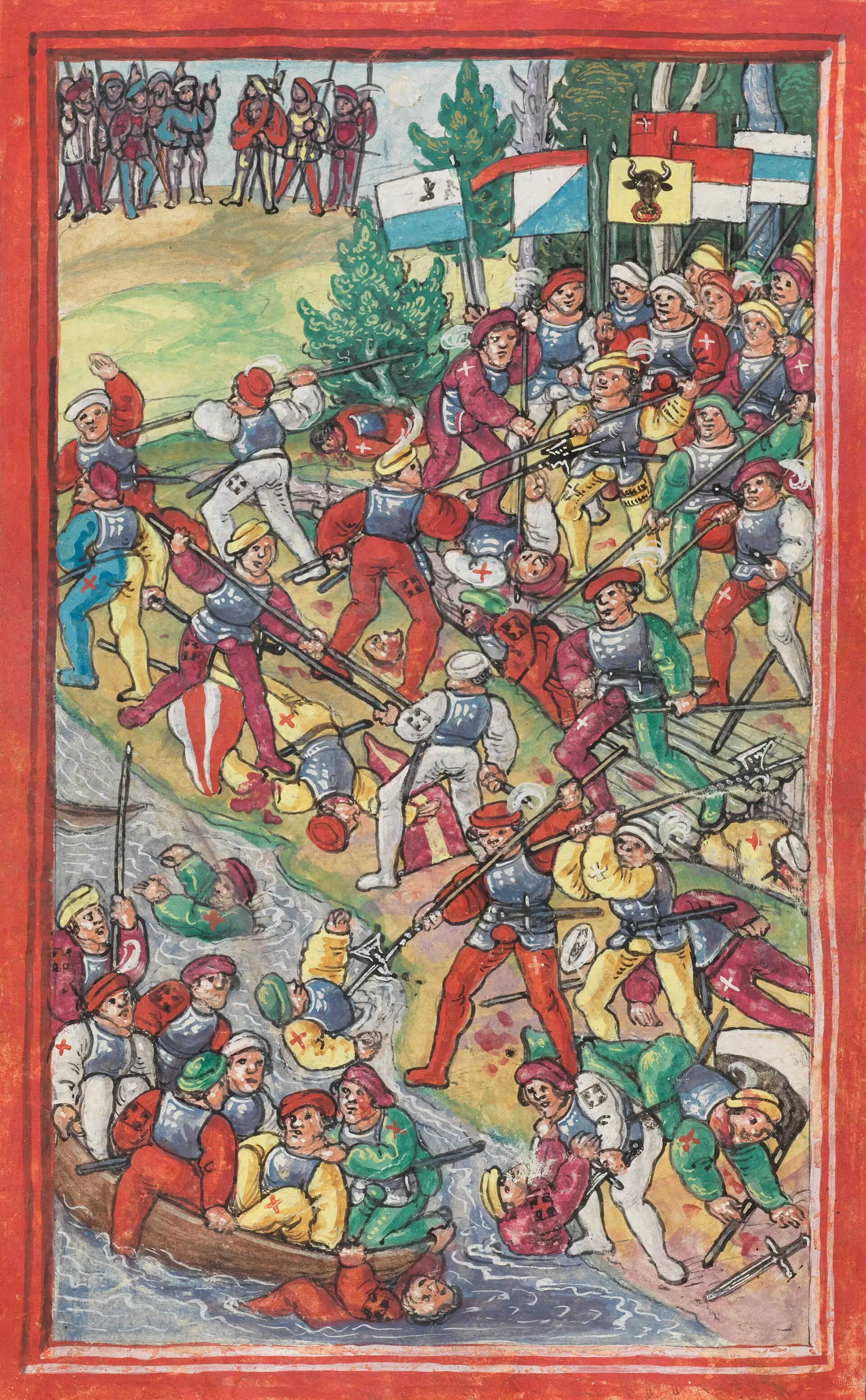
In 1499 Swiss and Grisons troops routed the Swabian League at Triesen and burned Vaduz Castle.

1510 – 1698
Faith, war, witch trials and debt.
Under the counts of Sulz and Hohenems the territory stayed Catholic and imperial, suffered the Thirty Years' War and plague, the witch trials of 1648–80 and the bankruptcy that led to its sale.
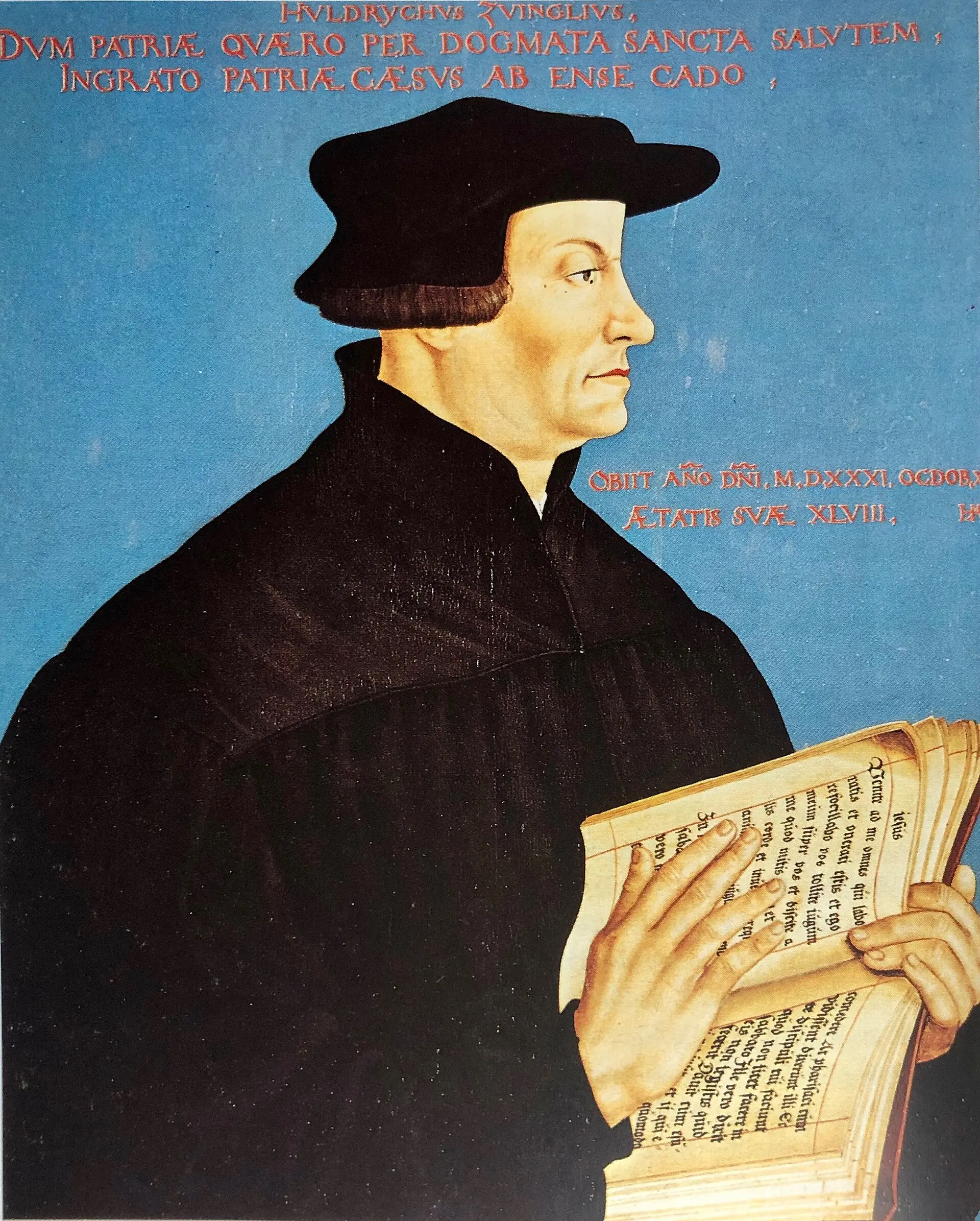
Count Rudolf V of Sulz forbade marriage with Protestants and kept his lands Catholic.

Plague came with imperial troops, and in 1647 Swedish raiders extorted 14,800 guilders.

Trials under Count Ferdinand Karl of Hohenems sent 45 people to their deaths in 1679–1680.

Petitioned by the subjects, Emperor Leopold I removed the count and placed the lordships under imperial administration.

1699 – 1805
Bought, united and ruled from Vienna.
The princes of Liechtenstein bought Schellenberg (1699) and Vaduz (1712) to gain a seat in the Imperial Diet; in 1719 Emperor Charles VI united them as the Imperial Principality of Liechtenstein, ruled from Vienna through bailiffs.

Prince Hans-Adam I bought Schellenberg in 1699 and the County of Vaduz in 1712.

Johann Christoph von Bentz became the first Landvogt, heading the princely administration in Vaduz.

In 1723 the Prince of Liechtenstein took his seat and vote in the Council of Princes of the Imperial Diet.

In 1799 Masséna's French army crossed the Rhine into Liechtenstein and plundered the villages.

1806 – 1865
Sovereignty, reform and revolution.
Napoleon's Confederation of the Rhine made Liechtenstein sovereign in 1806; it joined the German Confederation, abolished serfdom, entered a customs union with Austria (1852) and received its 1862 constitution.

Johann I's administration abolished the remaining serfdom in 1808.

A popular assembly chose Peter Kaiser and others to lead a peaceful movement for reform.

The customs treaty of 1852 joined Liechtenstein to the Austrian customs area.

Johann II's constitution of 1862 created an elected Landtag and guaranteed civil rights.

1866 – 1918
No army, a railway and the first mills.
After the last military contingent of 1866 the principality disbanded its army; Johann II's long reign brought the railway, textile mills and cultural patronage, while the First World War brought hardship.

Swiss entrepreneurs built cotton mills in Vaduz and Triesen, the country's first factory industry.

The line from Feldkirch to Buchs, still the only railway in the country, opened in 1872.

The Vaduz-born composer and organist Josef Rheinberger died in Munich in 1901.

Johann II had the neglected Vaduz Castle restored and enlarged as a future princely residence.
Population: Linear interpolation between 1910 (Wikipedia, Demographics of Liechtenstein: 1910, 8,500) and 1920 (Wikipedia, Demographics of Liechtenstein: 1920, 8,800).

1919 – 1938
From Austria to Switzerland.
After Austria-Hungary's collapse Liechtenstein turned west: the 1921 constitution, the Swiss franc, the 1923 customs treaty with Switzerland and the rise of the FBP and VU parties.

As the Austrian krone collapsed, the Swiss franc became Liechtenstein's currency in 1920.

The treaty of 1923 created the economic union with Switzerland that still stands.

The Persons and Companies Act of 1926 laid the foundation of the financial centre.

In 1927 the Rhine burst its dykes above Schaan and flooded the Unterland.
Population: Linear interpolation between 1930 (Wikipedia, Demographics of Liechtenstein: 1930, 9,900) and 1940 (Wikipedia, Demographics of Liechtenstein: 1940, 10,900).

1939 – 1989
Neutrality, industry and prosperity.
The first prince to live in Vaduz kept the country neutral through the Second World War; industry and the financial centre turned a poor farming state into one of the richest in the world, and women won the vote in 1984.

A Nazi putsch attempt failed in March 1939, and the country stayed neutral under Swiss protection.

The Hilti brothers opened a workshop in Schaan in 1941 that grew into a global toolmaker.

In May 1945 some 500 soldiers and civilians of the First Russian National Army were granted asylum.

After defeats in 1971 and 1973, male voters narrowly approved women's suffrage in 1984.
Population: Linear interpolation between 1980 (Wikipedia, Demographics of Liechtenstein: 1980, 25,500) and 1990 (Wikipedia, Demographics of Liechtenstein: 1990, 28,700).

1990 – present
Into the world, and a new balance of power.
UN, EFTA and EEA membership, the strengthening of the prince's powers in 2003, financial-centre reform after 2000 and 2008, Alois's regency and Liechtenstein's first female head of government in 2025.

Voters approved joining the European Economic Area in 1992, a week after Switzerland said no.

In 2003 voters approved the Prince's constitutional initiative, extending his powers, by 64.3 per cent.

The tax affair of 2008 led Liechtenstein to accept OECD standards of tax transparency.

Brigitte Haas became the first woman to head Liechtenstein's government in 2025.
Population: Linear interpolation between 2020 (Wikipedia, Demographics of Liechtenstein: 2020, 38,896) and 2025 (Wikipedia, Demographics of Liechtenstein: 2025, 41,024).
From Roman Raetia to the Principality, 15 BCE – Today
From Rhaetian hillforts and the Roman road to the counts of Vaduz and the lords of Schellenberg, from the purchase by the House of Liechtenstein to sovereignty, the customs unions with Austria and Switzerland and today’s principality, municipality by municipality, in 20 narrated chapters.
If the page stays blank, the site doesn't allow embedding — use “Open in new tab”.
From the hilltop settlements of the Eschnerberg to the constitutional referendum of 2003, the history of Liechtenstein has left Europe the last surviving principality of the Holy Roman Empire, a state without an army since 1868, a lasting partnership with Switzerland, a monarchy with real powers beside a lively direct democracy, and the example of a poor Alpine farming land that became one of the richest countries in the world.
Created by Emperor Charles VI in 1719 from two small lordships bought to win a seat in the Imperial Diet, Liechtenstein is the last surviving principality of the Holy Roman Empire. It outlived the Empire, the Confederation of the Rhine and the German Confederation, and today, with about 41,000 people on 160 square kilometres, it is one of the smallest sovereign states in the world.
Liechtenstein disbanded its army of 80 men in 1868 and has had no armed forces since. It stayed neutral in both world wars, withstood a Nazi putsch attempt in 1939, and in 1945 gave asylum to some 500 soldiers and civilians of the First Russian National Army and refused Soviet demands to hand them over, an episode commemorated at Hinterschellenberg.
Since the customs treaty of 1923 Liechtenstein has formed a single economic area with Switzerland, and it has used the Swiss franc since 1920, confirmed by the currency treaty of 1980. Membership of the European Economic Area since 1995, alongside the Swiss union, gives it a rare place between the Swiss and the European single markets.
Unlike most European monarchs, the Prince of Liechtenstein keeps real powers. Under the constitution of 1921, as revised by the referendum of 2003, he can veto laws and dismiss the government, while the people may in turn call a vote to abolish the monarchy. The princes, who ruled from Vienna for more than two centuries, have lived in Vaduz Castle since 1938.
The constitution of 1921 gave citizens the popular initiative and the referendum, and votes on questions from the European Economic Area to the prince's veto have shaped national life. Yet women, refused the vote by male electors in 1971 and 1973, won it only in 1984, the last in Europe to do so.
The Princely Collections, gathered over four centuries and brought to Vaduz from Vienna and Moravia in 1944–1945, are among the great private art collections of the world, with masterpieces by Rubens and Van Dyck. The Kunstmuseum Liechtenstein opened in Vaduz in 2000, and the Vaduz-born Josef Rheinberger was one of the leading organ composers of the nineteenth century.
Once one of the poorest corners of the Alps, Liechtenstein industrialised with Swiss textile mills and, from the 1940s, with high-technology firms such as Hilti and Balzers. The company law of 1926 made it a centre for trusts, foundations and private banking; after the crises of 2000 and 2008 it adopted international standards of tax transparency.
Walser colonists from the Valais settled Triesenberg about 1300, and their dialect and traditions still mark the mountain village. With the castles of Vaduz and Gutenberg, the Roman fort at Schaan, the prehistoric sites of the Eschnerberg and the eleven municipalities of the Oberland and Unterland, they keep alive the older landscape of the Alpine Rhine valley.
The timeline is built from the project's own research dossier and its event, ruler, head-of-government and map datasets, checked against the Historisches Lexikon des Fürstentums Liechtenstein, English Wikipedia, Encyclopaedia Britannica, the Historical Dictionary of Switzerland and other references. Linked articles are starting points for verification, not proof that every claim has been independently checked. Prehistoric dates are archaeological estimates, the earliest lords of Schellenberg and counts of Montfort and Werdenberg appear as families because individual holders cannot be dated, and some lexicon references point to search pages rather than single articles. Population figures begin in 1901; no reliable earlier series was used. Where sources disagree, as on the first mention of Vaduz, the site says so. The most recent events, from 2024 to 2026, rest on sources that are still changing; the shading of municipalities and neighbouring states on the map is indicative.
Every event and every ruler has its own sources. See Sources & Further Reading in each timeline entry and ruler profile.
History is connected. Explore the bigger picture.
AllHistories is an independent visual history project designed to make the past easier to understand, explore, and connect.
History is more than a collection of dates, rulers, and battles. Events rarely happen in isolation. Borders shift, civilizations influence one another, ideas spread, and decisions made centuries ago continue to shape the world today.
Through interactive timelines, historical maps, and visual storytelling, AllHistories helps uncover these connections and makes complex historical subjects more accessible and engaging.
Travel through centuries, discover turning points, and understand how historical events unfold and connect.
Explore how borders, civilizations, populations, trade routes, beliefs, and spheres of influence have changed over time.
Go beyond dates and discover the individuals, places, decisions, and circumstances behind historical developments.
Explore connections between countries, empires, civilizations, and historical themes to better understand cause and consequence.
Features vary depending on the historical subject.
AllHistories draws on historical research, published references, public archives, and available historical datasets. The information is organized and presented through interactive digital experiences.
History is not always certain or universally agreed upon. Dates, territorial boundaries, population figures, and interpretations may differ between sources. Some information is necessarily simplified or estimated for visual presentation.
The goal is to encourage curiosity and independent exploration, not to replace academic publications or specialist historical research.
When you visit AllHistories, the web server may process technical information such as your IP address, requested pages, browser details and access times to deliver pages and maintain the service.
Some pages load Google Analytics, Google Fonts, externally hosted images, maps or other third-party resources. Requests to these providers can transmit technical information, including your IP address. Contact forms may use Google reCAPTCHA to help prevent abuse. These providers apply their own privacy policies.
The website uses browser storage for preferences such as the selected theme. Country microsites also use a session cookie to support website functionality, including request protection. Analytics or other third-party services may use additional cookies or storage, depending on the page and your browser settings.
When you submit a correction or contact form, the information you provide, such as your name, email address and message, is processed to review and respond to your request. Please avoid including sensitive personal information.
You can manage cookies and site storage in your browser and control third-party requests through browser privacy settings. For privacy questions or requests concerning information you submitted, use the contact option on the microsite where you sent it.
Links to sources and other websites take you to services with their own privacy practices. Review their policies before providing personal information.
AllHistories provides historical information for general education and exploration. Its content is not professional, legal, financial or other specialist advice.
We aim to present useful, well-sourced summaries, but cannot guarantee that every date, statement, translation or interpretation is complete or accurate. Verify important claims against the cited sources and relevant scholarship. Content may be corrected or updated.
Maps are simplified historical illustrations. Borders, place names and territorial labels may vary by period and source. Their appearance does not express a position on sovereignty or present-day territorial disputes.
Images and source material may belong to their respective creators or rights holders. Consult the image credit, source page and license before reusing material. A link or credit does not grant additional reuse rights.
External links are provided for reference. AllHistories does not control the content, availability or policies of third-party websites.
To report an error or a concern about credited material, use the contact option on the relevant country microsite and identify the page, material and supporting details.