Key facts of the era
Key Events
Scroll the timeline, open an event, and discover the people and turning points that shaped the United States.
Explore the presidents of the United States, their terms in office, party affiliations, and succession.
A federal republic born in a colonial revolt, stretched across a continent in a single century, and a world power since the Second World War.
Long before Europeans came, peoples such as the mound builders of Cahokia farmed and traded across the continent. After the English settled Jamestown in 1607, thirteen colonies took shape along the Atlantic coast.
Disputes over taxes and self-rule led the colonies to issue the Declaration of Independence in 1776 and to win the war that followed. The Constitution of 1787 set up a federal republic, which George Washington led as its first president from 1789.
Purchases, treaties and war carried the young nation to the Pacific, while slavery drove North and South apart. The Civil War of 1861 to 1865 saved the Union, and the 13th Amendment ended slavery.
Industry and mass immigration made the country a great power, and World War II left it facing the Soviet Union in the Cold War. The civil rights movement broke down legal segregation, and after the Soviet collapse in 1991 the US stood as the only superpower.
Census Bureau estimates for 1 July of each year. The country has added more than 90 million people since 1990.
Countries that share a land border with the United States
 Canadanorth
 Mexicosouth

Thirteen red and white stripes for the founding colonies and fifty white stars on blue for today’s states. Congress adopted the first version on 14 June 1777; the present design has flown since 1960, after Hawaii became a state.

A bald eagle holds an olive branch and thirteen arrows, with the motto E pluribus unum on a scroll and thirteen stars above. Congress approved the design by Charles Thomson on 20 June 1782; its front serves as the national coat of arms.
Image credits
Pictures on this page, from Wikimedia Commons and Natural Earth
 United States CapitolUnited_States_Capitol_-_west_front.jpg: Architect of the Capitol derivative work: O.J.Public domain
 President George WashingtonGilbert StuartPublic domainFlag of the United StatesRoc0ast3rCC0Great Seal of the United States (obverse)U.S. GovernmentPublic domainFlag of CanadaGeorge F. G. Stanley (design); SVG: E Pluribus Anthony / MzajacPublic domainFlag of MexicoMexican Government (SVG: Omar Alejandro Covarrubias Neri)Public domain
From Thirteen States to Fifty, 1783 – 1959
From a strip of former colonies along the Atlantic to a union of fifty states. Watch the borders move as land was purchased, ceded, annexed and taken — and see when each territory became a state.
Each year shows the map as of December 31. Historical state and territorial outlines come from the Newberry Library’s Atlas of Historical County Boundaries, converted to SVG; muted outlines show today’s fifty states for reference, and Alaska and Hawaii appear as repositioned insets. The map covers the land of today’s fifty states, not all U.S. overseas possessions, and small boundary details are generalized.
These are governmental boundaries and claims, not a map of settlement or uncontested control. Indigenous nations held lands and sovereignty across these regions; U.S. expansion involved dispossession, warfare and forced removal. Hatching marks separate republics and disputed claims. Civil War colors describe each state’s alignment, not front lines; Indian Territory contained divided nations and is shown as territory.
If the page stays blank, the site doesn't allow embedding — use “Open in new tab”.
United States history has left a complex constitutional, cultural, social, and global legacy. Its ideals have inspired generations, while the gap between those ideals and lived reality continues to drive change.
American music, film, literature, technology, and political ideas have circulated worldwide, creating influence as well as debate about power and cultural exchange.
The Constitution created a durable federal system built around divided powers, representative government, and amendment. Its interpretation remains a central arena of American public life.
Abolition, women’s suffrage, labor organizing, civil rights, disability rights, and other movements repeatedly expanded who could claim the nation’s promises of liberty and equality.
The legacies of Indigenous dispossession, slavery, immigration, expansion, war, and reform still shape institutions and communities. American history remains a living argument about the country it should become.
The Immigration and Nationality Act of 1965 ended the national-origins quota system, prioritizing family ties and certain skills. It helped reshape migration to the United States, adding new chapters to the country’s long debate over opportunity and belonging.
National Archives: Immigration Act of 1965Native nations remain active governments. The Indian Self-Determination and Education Assistance Act of 1975 enabled tribes to administer programs previously run by federal agencies, strengthening tribal control over services and community priorities.
Indian Affairs: Tribal self-determinationThe Morrill Act of 1862 supported land-grant colleges teaching agriculture and engineering, broadening access to higher education. That expansion also depended on land taken from Native communities, linking a lasting educational achievement to dispossession.
National Archives: Morrill ActApollo 11 landed humans on the Moon in July 1969. Beyond the first footsteps, the mission returned lunar samples and deployed scientific instruments, demonstrating how public investment, engineering, and exploration could extend human knowledge beyond Earth.
NASA: Apollo 11 mission overviewSome chapters of the United States’ past are too big for a single timeline entry. Each of these has a site of its own, with maps, people, sources and the full story, told from start to finish.
 The British Empire
The sun never set. Then, in thirty years, it did. How a small island came to rule a quarter of the world and let it go within one lifetime: fifteen dispatches, a map through time, 407 events, monarchs, prime ministers and what-ifs.
Read the story
(opens in a new tab)
 The American Civil War
The war that remade America. Eleven states left, four million people were freed, about 698,000 died: causes, battles, cost and Reconstruction, 1861 to 1865.
Read the story
(opens in a new tab)
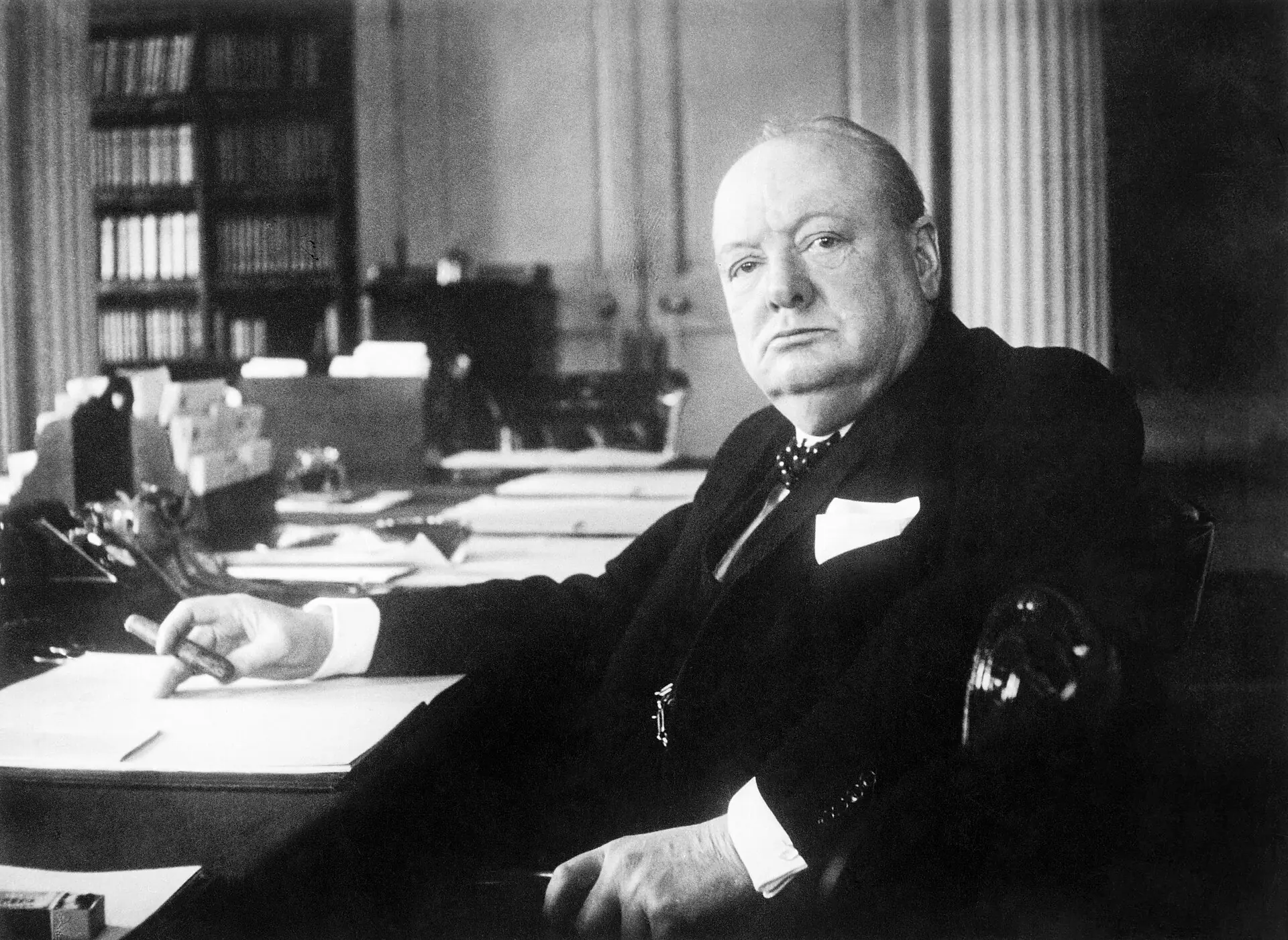 Winston Churchill
The man Britain needed most. The life of the soldier, reporter and twice prime minister who led Britain through the Second World War: eleven chapters, the cabinet of May 1940, the map of his journeys and wars, the people around him and the case for and against.
Read the life
(opens in a new tab)
 World War I
Two shots. Thirty-seven days. Four empires gone. How a wrong turn in Sarajevo became a world war: the July Crisis, the fronts year by year, the cost, the fall of four empires and the peace that led to the next war.
Read the story
(opens in a new tab)
The timeline draws on national archives, museum collections, reference works and survey histories of the United States. Linked collections are starting points for further reading and verification, not proof that every claim has been independently checked.
Every event and every president has its own sources. See Sources & Further Reading in each timeline entry and president profile.
History is connected. Explore the bigger picture.
AllHistories is an independent visual history project designed to make the past easier to understand, explore, and connect.
History is more than a collection of dates, rulers, and battles. Events rarely happen in isolation. Borders shift, civilizations influence one another, ideas spread, and decisions made centuries ago continue to shape the world today.
Through interactive timelines, historical maps, and visual storytelling, AllHistories helps uncover these connections and makes complex historical subjects more accessible and engaging.
Travel through centuries, discover turning points, and understand how historical events unfold and connect.
Explore how borders, civilizations, populations, trade routes, beliefs, and spheres of influence have changed over time.
Go beyond dates and discover the individuals, places, decisions, and circumstances behind historical developments.
Explore connections between countries, empires, civilizations, and historical themes to better understand cause and consequence.
Features vary depending on the historical subject.
AllHistories draws on historical research, published references, public archives, and available historical datasets. The information is organized and presented through interactive digital experiences.
History is not always certain or universally agreed upon. Dates, territorial boundaries, population figures, and interpretations may differ between sources. Some information is necessarily simplified or estimated for visual presentation.
The goal is to encourage curiosity and independent exploration, not to replace academic publications or specialist historical research.
When you visit AllHistories, the web server may process technical information such as your IP address, requested pages, browser details and access times to deliver pages and maintain the service.
Some pages load Google Analytics, Google Fonts, externally hosted images, maps or other third-party resources. Requests to these providers can transmit technical information, including your IP address. Contact forms may use Google reCAPTCHA to help prevent abuse. These providers apply their own privacy policies.
The website uses browser storage for preferences such as the selected theme. Country microsites also use a session cookie to support website functionality, including request protection. Analytics or other third-party services may use additional cookies or storage, depending on the page and your browser settings.
When you submit a correction or contact form, the information you provide, such as your name, email address and message, is processed to review and respond to your request. Please avoid including sensitive personal information.
You can manage cookies and site storage in your browser and control third-party requests through browser privacy settings. For privacy questions or requests concerning information you submitted, use the contact option on the microsite where you sent it.
Links to sources and other websites take you to services with their own privacy practices. Review their policies before providing personal information.
AllHistories provides historical information for general education and exploration. Its content is not professional, legal, financial or other specialist advice.
We aim to present useful, well-sourced summaries, but cannot guarantee that every date, statement, translation or interpretation is complete or accurate. Verify important claims against the cited sources and relevant scholarship. Content may be corrected or updated.
Maps are simplified historical illustrations. Borders, place names and territorial labels may vary by period and source. Their appearance does not express a position on sovereignty or present-day territorial disputes.
Images and source material may belong to their respective creators or rights holders. Consult the image credit, source page and license before reusing material. A link or credit does not grant additional reuse rights.
External links are provided for reference. AllHistories does not control the content, availability or policies of third-party websites.
To report an error or a concern about credited material, use the contact option on the relevant country microsite and identify the page, material and supporting details.