Key facts of the era
Key Events
Journey through the events, people, wars and ideas that shaped Norway, from the hunters who followed the retreating ice to the present day.
Follow the rock carvers of Alta and the chieftains of the Iron Age, the Vikings from Lindisfarne to Vinland, Harald Fairhair and Saint Olaf, the civil wars and the golden age of Haakon IV, the Black Death and the Kalmar Union, four centuries with Denmark, the Constitution of Eidsvoll, the union with Sweden and independence in 1905, the German occupation, the welfare state and the oil age.
From Harald Fairhair and the Earls of Lade through the kings of the civil wars and the golden age, the union kings of the Kalmar Union, Denmark–Norway and Sweden–Norway, to the House of Glücksburg since 1905, with the regents of the interregna and the first ministers and prime ministers who governed Norway.
A Nordic kingdom of fjords and long coasts that grew out of Viking-age realms, spent over four centuries bound to Denmark and ninety years in union with Sweden, and stood on its own from 1905.
Chieftains and farmers ruled the fjords when Viking crews raided Lindisfarne in 793 and went on to settle the Atlantic islands, Iceland and Greenland. Tradition dates a first united kingdom to Harald Fairhair and his victory at Hafrsfjord around 872, and the fall of Olaf II at Stiklestad in 1030 gave the newly Christian realm its patron saint.
After a century of civil wars the kingdom reached its widest extent under Haakon IV, when Greenland and Iceland accepted the Norwegian crown in the 1260s. The Black Death of 1349 emptied many farms, the Kalmar Union of 1397 put Norway under one ruler with Denmark and Sweden, and from 1536 it was governed from Copenhagen as part of Denmark–Norway.
When Denmark had to hand Norway to Sweden in the Treaty of Kiel, an assembly at Eidsvoll drew up a constitution dated 17 May 1814. The country kept it through ninety years of union with Sweden under a shared king, until the Storting ended the union on 7 June 1905 and a Danish prince took the throne as Haakon VII.
German troops invaded on 9 April 1940 and held the country until May 1945, while the king and government carried on from London. Norway then helped found NATO, grew rich on oil after the Ekofisk find of 1969 and stayed outside the European Union after no votes in 1972 and 1994; in August 2026 Haakon VIII succeeded his father, Harald V.
On 1 January of each year. Norway has gained some 1.4 million people since 1990, and since 2005 about two thirds of the growth has come from immigration.
Countries that share a border with Norway

Red with a blue Nordic cross edged in white, proposed by the Storting member Fredrik Meltzer and adopted in 1821. A union mark shared with Sweden sat in its upper corner from 1844; a law of 1898 took it off the merchant flag, and the navy dropped it in 1905.

A crowned golden lion on red holds the axe of St Olaf. Lions mark royal seals from the 13th century, King Eric II added the crown and axe around 1280, and today’s drawing of 1992 follows a royal resolution of 1937.
Image credits
Pictures on this page, from Wikimedia Commons and Natural Earth
 GeirangerfjordFataMorganaCC BY-SA 3.0
 King Olaf II (St. Olaf) at Stiklestad (painting)Peter Nicolai ArboPublic domainFlag of NorwayMaarten HeerlienCC BY 2.0Coat of arms of NorwayEmblazonment by Sverre Morken (1992), redrawn by Jonas Madsen Rogne (2023) on behalf of the Norwegian Government Design ProgrammePublic domain
Norway’s Lands Through Time, c. 9000 BCE – Today
Follow Norway’s lands from the first hunters on an ice-free coast, through the petty kingdoms and the Viking settlements from Dublin to Greenland, the medieval realm and its tributary islands, four centuries with Denmark and the lands lost to Sweden, the union with Sweden, independence and the Arctic, to the Norway of today. Each of 46 zones is coloured by who held it, in 30 narrated chapters.
King of Sweden and Norway (Sweden–Norway)
Charles XV, known in Norway as Charles IV, was popular among Norwegians. Swedish opposition blocked his promise to abolish the office of governor-general in Norway.

Click to expand • 4 family members
If the page stays blank, the site doesn't allow embedding — use “Open in new tab”.
From the rock carvings of Alta to the oil fund, the history of Norway has left the sagas and the stave churches, a seafaring tradition that reached from Dublin to Vinland, two written forms of Norwegian, one of the world's oldest written constitutions still in force, the plays of Ibsen and the paintings of Munch, the polar journeys of Nansen and Amundsen, the memory of occupation and resistance, and a wealthy welfare state that has chosen to save its oil money for future generations.
Runes were cut in Norway from about 180, and the kings' sagas written in Iceland, above all Snorri Sturluson's Heimskringla, made Norway's early kings famous. Under Denmark, Danish became the written language; in the nineteenth century Ivar Aasen built Nynorsk on the rural dialects while Dano-Norwegian grew into Bokmål, and both remain official. The Sámi languages have official status, and Jon Fosse, who writes in Nynorsk, won the Nobel Prize in Literature in 2023.
Viking ships such as Oseberg and Gokstad carried Norwegians to the British Isles, the Faroes, Iceland, Greenland and Vinland, and Norse place names and law survive across the North Atlantic. Later the merchant fleet became one of the largest in the world and served the Allies in the Second World War. Nansen crossed Greenland and drifted across the Arctic in Fram, Amundsen was first through the Northwest Passage and first at the South Pole, and Heyerdahl crossed the Pacific on Kon-Tiki.
The regional assemblies of the Gulating and Frostating, Magnus the Lawmender's national law of 1274 and the Norwegian Codes of 1604 and 1687 kept Norway a land of its own law even under Danish rule. The Eidsvoll Constitution of 17 May 1814, still in force and celebrated every Constitution Day, gave power to an elected Storting; the impeachment of 1884 established parliamentary government, and the vote was extended to all men in 1898 and to women in 1913.
Norway's medieval stave churches, with Urnes and Borgund the best known, joined Viking ornament to Christian architecture, and Nidaros Cathedral rose over the shrine of Saint Olaf, the goal of pilgrims for centuries. The Rock Art of Alta, Urnes Stave Church, Bryggen in Bergen and the mining town of Røros are among Norway's UNESCO World Heritage Sites, and the Oseberg and Gokstad ships are among the best-preserved Viking ships ever found.
In the late nineteenth century a small country produced world-famous art. Henrik Ibsen's Peer Gynt, A Doll's House and Hedda Gabler changed modern drama, Edvard Grieg's music for Peer Gynt and his piano concerto drew on Norwegian folk music, and Edvard Munch's The Scream became an icon of modern anxiety. Bjørnson, Hamsun and Undset won Nobel Prizes in Literature, and Bjørnson's Ja, vi elsker dette landet became the national anthem.
The five years of German occupation from 1940 to 1945 shaped modern Norway: the King's refusal to appoint Quisling, whose name became a byword for traitor, the government in exile, the merchant fleet, the Home Front and the saboteurs of Vemork. The deportation of Norway's Jews, the burning of Finnmark and North Troms and the post-war legal purge are remembered too, and the experience led Norway to abandon neutrality and help found NATO in 1949.
Since 1901 a committee appointed by the Storting has awarded the Nobel Peace Prize in Oslo. Fridtjof Nansen's work for refugees, Trygve Lie as the first Secretary-General of the United Nations, the Brundtland Report on sustainable development and the Oslo Accords of 1993 made Norway a voice in international affairs. Norway twice voted against joining the European Union but is bound to Europe through the EEA, and is a founding member of NATO.
Hydropower built Norway's first industries, and the National Insurance Scheme of 1967 completed a universal welfare state. The discovery of Ekofisk in 1969 made Norway one of the world's richest countries; the state kept control through Statoil, today Equinor, and saves its oil revenue in the Government Pension Fund Global, the world's largest sovereign wealth fund, spending only its expected return. Today almost all new cars sold in Norway are electric.
Some chapters of Norway’s past are too big for a single timeline entry. Each of these has a site of its own, with maps, people, sources and the full story, told from start to finish.
 History of the Vikings
Raiders, traders and settlers of the northern seas. Explore the origins, voyages and legacy of the Viking Age across Norway and beyond.
Read the story
(opens in a new tab)
 Oslo
Burned. Moved by a king. Renamed three times. Reborn on the fjord. Burned, moved by a king, renamed and reborn on the fjord: a thousand years of Norway's capital, from Viking meadow to Fjord City.
Read the story
(opens in a new tab)
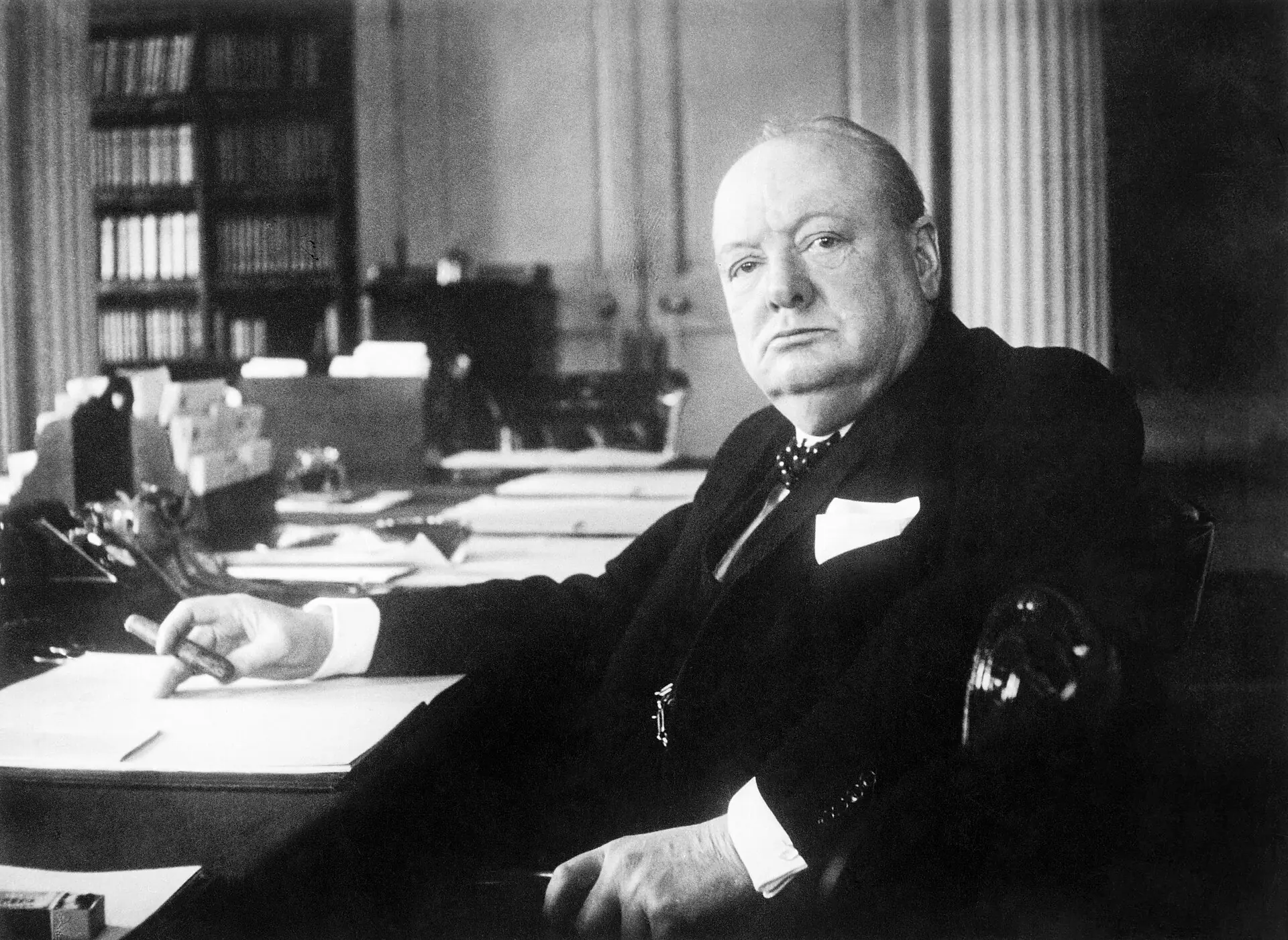 Winston Churchill
The man Britain needed most. The life of the soldier, reporter and twice prime minister who led Britain through the Second World War: eleven chapters, the cabinet of May 1940, the map of his journeys and wars, the people around him and the case for and against.
Read the life
(opens in a new tab)
The timeline is built from the project's own research dossier and its event, ruler, prime minister and map datasets, checked against English Wikipedia, Store norske leksikon, Norsk biografisk leksikon, norgeshistorie.no, the Government of Norway, the Royal House and other references. Linked articles are starting points for verification, not proof that every claim has been independently checked. Prehistoric dates and the reigns of the Viking Age rest on archaeology and on sagas written two or three centuries later and are approximate; Harald Fairhair's victory at Hafrsfjord is shown at the traditional 872, which many historians place in the 880s. Dates follow the New Style where sources give one, conflicting figures are both given, the most recent events rest on sources that are still changing, and the map's historical zones are reconstructions.
Every event and every ruler has its own sources. See Sources & Further Reading in each timeline entry and ruler profile.
History is connected. Explore the bigger picture.
AllHistories is an independent visual history project designed to make the past easier to understand, explore, and connect.
History is more than a collection of dates, rulers, and battles. Events rarely happen in isolation. Borders shift, civilizations influence one another, ideas spread, and decisions made centuries ago continue to shape the world today.
Through interactive timelines, historical maps, and visual storytelling, AllHistories helps uncover these connections and makes complex historical subjects more accessible and engaging.
Travel through centuries, discover turning points, and understand how historical events unfold and connect.
Explore how borders, civilizations, populations, trade routes, beliefs, and spheres of influence have changed over time.
Go beyond dates and discover the individuals, places, decisions, and circumstances behind historical developments.
Explore connections between countries, empires, civilizations, and historical themes to better understand cause and consequence.
Features vary depending on the historical subject.
AllHistories draws on historical research, published references, public archives, and available historical datasets. The information is organized and presented through interactive digital experiences.
History is not always certain or universally agreed upon. Dates, territorial boundaries, population figures, and interpretations may differ between sources. Some information is necessarily simplified or estimated for visual presentation.
The goal is to encourage curiosity and independent exploration, not to replace academic publications or specialist historical research.
When you visit AllHistories, the web server may process technical information such as your IP address, requested pages, browser details and access times to deliver pages and maintain the service.
Some pages load Google Analytics, Google Fonts, externally hosted images, maps or other third-party resources. Requests to these providers can transmit technical information, including your IP address. Contact forms may use Google reCAPTCHA to help prevent abuse. These providers apply their own privacy policies.
The website uses browser storage for preferences such as the selected theme. Country microsites also use a session cookie to support website functionality, including request protection. Analytics or other third-party services may use additional cookies or storage, depending on the page and your browser settings.
When you submit a correction or contact form, the information you provide, such as your name, email address and message, is processed to review and respond to your request. Please avoid including sensitive personal information.
You can manage cookies and site storage in your browser and control third-party requests through browser privacy settings. For privacy questions or requests concerning information you submitted, use the contact option on the microsite where you sent it.
Links to sources and other websites take you to services with their own privacy practices. Review their policies before providing personal information.
AllHistories provides historical information for general education and exploration. Its content is not professional, legal, financial or other specialist advice.
We aim to present useful, well-sourced summaries, but cannot guarantee that every date, statement, translation or interpretation is complete or accurate. Verify important claims against the cited sources and relevant scholarship. Content may be corrected or updated.
Maps are simplified historical illustrations. Borders, place names and territorial labels may vary by period and source. Their appearance does not express a position on sovereignty or present-day territorial disputes.
Images and source material may belong to their respective creators or rights holders. Consult the image credit, source page and license before reusing material. A link or credit does not grant additional reuse rights.
External links are provided for reference. AllHistories does not control the content, availability or policies of third-party websites.
To report an error or a concern about credited material, use the contact option on the relevant country microsite and identify the page, material and supporting details.