Key facts of the era
Key Events
Scroll through the centuries, meet the rulers, and explore the moments that shaped Japan.
Explore Japan’s emperors, shoguns, regents, ruling houses, and lines of succession, and every prime minister since 1885.
An island chain off East Asia where imperial courts, warrior governments and a modern parliamentary state followed one another over some fifteen centuries.
Rice farming came to the islands from the mainland about three thousand years ago, and by the 3rd century AD the Yamato rulers were raising giant keyhole-shaped tombs. Buddhism, Chinese writing and court law followed from the continent and shaped the capitals of Nara and Heian-kyō.
From the late 12th century real power lay with warrior governments: Minamoto no Yoritomo became shōgun in 1192, and his Kamakura regime beat back two Mongol invasions. After a long age of civil war, Oda Nobunaga, Toyotomi Hideyoshi and Tokugawa Ieyasu pulled the country together again around 1600.
The Tokugawa shogunate kept the peace for more than 250 years and kept foreign contact on a tight leash, until Matthew Perry’s warships forced the ports open in 1853–54. The Meiji Restoration of 1868 put the emperor back at the head of a state that industrialised fast and built an empire in Korea, Taiwan and beyond.
Expansion led to war with China and, from 1941, with the United States, ending in defeat after the atomic bombings of 1945. Under the 1947 constitution Japan rebuilt itself as a democracy with the emperor as a symbol, grew into one of the world’s largest economies, and now faces a shrinking and ageing population.
Census counts on 1 October of each year. The population peaked around 2010 and has fallen since, by 2.5% between the 2020 and 2025 censuses alone.
Japan has no land border; its nearest neighbours lie across the sea. Taiwan is governed by the Republic of China and its status is disputed.
 South Koreawest, across the Tsushima Strait

A red sun disc on a white field, called the Hinomaru. Sun banners were carried in medieval wars; the design became the merchant flag in 1870 but was fixed by law as the national flag only in 1999.

Japan has no official coat of arms. The golden sixteen-petal chrysanthemum is the crest of the emperor, formally adopted in 1926 after centuries of use, and stands in as a national emblem, for example on passports; the cabinet uses a paulownia crest.
Image credits
Pictures on this page, from Wikimedia Commons and Natural Earth
 Chureito Pagoda and Mount FujiDang SonCC0
 Tokugawa Ieyasu, founder of the Edo shogunateKanō Tan'yūPublic domainFlag of JapanDrawn for this collagePublic domain (national flag)Imperial Seal of JapanPhilip NilssonPublic domainFlag of South KoreaGovernment of the Republic of Korea (SVG: Great Brightstar and others)Public domain
From the Jōmon to the Present, c. 10,000 BCE – Today
Twelve thousand years of Japan on one map: Jōmon and Yayoi cultures, the Yamato kings and the court state that pushed north against the Emishi, the shogunates and the Ryukyu Kingdom, the opening of Ezo and the Kurils, the Empire of Japan from Taiwan to the South Seas, defeat, occupation and the return of Okinawa. Move through 42 narrated chapters.
Move through the 42 chapters: each shows every polity recorded for its year. The Japanese state is gold, from the Wa statelets and Yamato to the shogunates, the Empire and today’s Japan; rival Japanese powers (the Northern Fujiwara, the Western Army of 1600, the shogunate loyalists of 1868) are a lighter gold. The Empire’s colonies and leased lands are copper, its occupied lands and puppet states hatched copper. The Ryukyu kingdoms are violet, hatched with gold while Ryukyu was a vassal of Satsuma and then a Japanese domain (1609–1879); the Emishi, Kumaso and Ainu lands are hatched sand; US-administered islands after 1945 are blue. Other powers named in the chapter are green, everything else grey. Borders are drawn for the chapter years only and fade from one chapter to the next. Hover a territory for its name and dates; click it to open its Wikipedia article.
Boundaries are approximate reconstructions. Before about 540 there are no recorded borders: the Wa statelets, the Yamatai confederation and Yamato are drawn from the spread of keyhole tombs and inscriptions, and the Jōmon, Yayoi, Epi-Jōmon, Satsumon and Okhotsk cultures are culture areas with a dashed outline. The Emishi, Kumaso and Ainu lands are the parts of their islands not held by a state at the time. Interior borders between rivals (1600, 1868) are coarse, and the wartime occupation lines are yearly snapshots. The Kurils and southern Sakhalin are drawn as they were actually held; the red dashed line from 1952 is Japan’s claim to the Northern Territories. The white dashed line is Japan’s border today, for orientation only.
Prime Minister of Japan
Uno Sousuke was prime minister for 2 months, under Akihito. Party: Liberal Democratic Party. In office: June 1989 – August 1989.

If the page stays blank, the site doesn't allow embedding — use “Open in new tab”.
Japan’s legacy is layered and contested: aesthetics, craftsmanship, religion and technology have travelled widely, while imperial expansion and militarism left painful consequences that still shape relations across East Asia today.
The world’s oldest continuous hereditary monarchy endured through regents, shoguns and modern reform. The Meiji Constitution of 1889 and the postwar Constitution of 1947 recast the emperor’s role and established a parliamentary democracy.
The Ritsuryō codes of the 7th–8th centuries, samurai house laws and Edo administration built a tradition of codified law and disciplined bureaucracy. Meiji legal reforms drew on European models, producing a distinctive modern civil-law system.
Japanese adapted Chinese characters into a script of its own, enabling works such as The Tale of Genji, haiku and Kabuki drama. Modern authors, manga and anime have given Japanese storytelling a vast global audience.
Meiji-era industrialisation, the postwar economic miracle and later leadership in electronics, automobiles and robotics made Japan a technological powerhouse. Rapid growth also brought pollution, overwork and demographic strain.
Japan’s empire annexed Korea and Taiwan and occupied much of East Asia before 1945, causing immense suffering. Atomic bombings, defeat and occupation followed; how the war is remembered remains contested within Japan and across the region.
Shinto shrines and Buddhist temples, Zen practice and seasonal festivals still structure daily life and the landscape. Their blending across centuries created a religious culture that is layered rather than exclusive.
Ukiyo-e prints, ceramics, gardens, the tea ceremony and wabi-sabi sensibilities shaped Japanese taste and influenced Western art through Japonisme. Traditional craft and contemporary design continue to inform one another.
The samurai ethos of duty, discipline and loyalty, later idealised as bushido, echoes in martial arts, corporate culture and popular imagination. Historians caution that this image is often more romantic than the varied reality of warrior life.
Some chapters of Japan’s past are too big for a single timeline entry. Each of these has a site of its own, with maps, people, sources and the full story, told from start to finish.
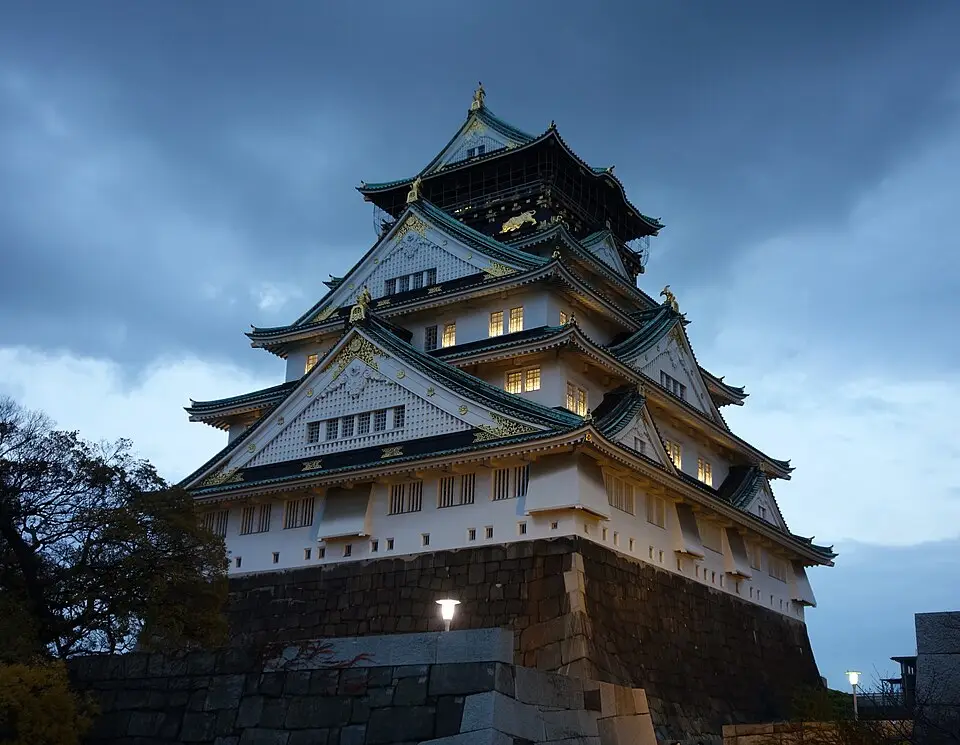 Osaka
The City That Fed a Nation How a harbour where Japan met the mainland became a capital, Hideyoshi's castle town, the merchants' kitchen of the nation and, after the fires of 1945, a city of neon and street food.
Read the story
(opens in a new tab)
 Kyoto
The thousand-year capital. How a grid city built in 794 to escape a ghost stayed Japan's capital for more than a thousand years, through fires, civil war and warlords, until its emperor left for Tokyo.
Read the story
(opens in a new tab)
The timeline draws on general histories, period studies and the collections of Japan’s national archives, libraries and museums. Linked articles are starting points for verification, not proof that every claim has been independently checked, and early dates — especially for prehistory and the traditional chronology of the first emperors — are approximate or legendary.
Every event and every ruler has its own sources. See Sources & Further Reading in each timeline entry and ruler profile.
History is connected. Explore the bigger picture.
AllHistories is an independent visual history project designed to make the past easier to understand, explore, and connect.
History is more than a collection of dates, rulers, and battles. Events rarely happen in isolation. Borders shift, civilizations influence one another, ideas spread, and decisions made centuries ago continue to shape the world today.
Through interactive timelines, historical maps, and visual storytelling, AllHistories helps uncover these connections and makes complex historical subjects more accessible and engaging.
Travel through centuries, discover turning points, and understand how historical events unfold and connect.
Explore how borders, civilizations, populations, trade routes, beliefs, and spheres of influence have changed over time.
Go beyond dates and discover the individuals, places, decisions, and circumstances behind historical developments.
Explore connections between countries, empires, civilizations, and historical themes to better understand cause and consequence.
Features vary depending on the historical subject.
AllHistories draws on historical research, published references, public archives, and available historical datasets. The information is organized and presented through interactive digital experiences.
History is not always certain or universally agreed upon. Dates, territorial boundaries, population figures, and interpretations may differ between sources. Some information is necessarily simplified or estimated for visual presentation.
The goal is to encourage curiosity and independent exploration, not to replace academic publications or specialist historical research.
When you visit AllHistories, the web server may process technical information such as your IP address, requested pages, browser details and access times to deliver pages and maintain the service.
Some pages load Google Analytics, Google Fonts, externally hosted images, maps or other third-party resources. Requests to these providers can transmit technical information, including your IP address. Contact forms may use Google reCAPTCHA to help prevent abuse. These providers apply their own privacy policies.
The website uses browser storage for preferences such as the selected theme. Country microsites also use a session cookie to support website functionality, including request protection. Analytics or other third-party services may use additional cookies or storage, depending on the page and your browser settings.
When you submit a correction or contact form, the information you provide, such as your name, email address and message, is processed to review and respond to your request. Please avoid including sensitive personal information.
You can manage cookies and site storage in your browser and control third-party requests through browser privacy settings. For privacy questions or requests concerning information you submitted, use the contact option on the microsite where you sent it.
Links to sources and other websites take you to services with their own privacy practices. Review their policies before providing personal information.
AllHistories provides historical information for general education and exploration. Its content is not professional, legal, financial or other specialist advice.
We aim to present useful, well-sourced summaries, but cannot guarantee that every date, statement, translation or interpretation is complete or accurate. Verify important claims against the cited sources and relevant scholarship. Content may be corrected or updated.
Maps are simplified historical illustrations. Borders, place names and territorial labels may vary by period and source. Their appearance does not express a position on sovereignty or present-day territorial disputes.
Images and source material may belong to their respective creators or rights holders. Consult the image credit, source page and license before reusing material. A link or credit does not grant additional reuse rights.
External links are provided for reference. AllHistories does not control the content, availability or policies of third-party websites.
To report an error or a concern about credited material, use the contact option on the relevant country microsite and identify the page, material and supporting details.