Key facts of the era
Key Events
Journey through the events, people, wars and ideas that shaped Greece and the Greek world, from the first humans in the Aegean to the present day.
Follow the Minoan palaces and Mycenae, the city-states, Marathon and Salamis, classical Athens and Sparta, Alexander the Great, Roman and Byzantine Greece, the fall of Constantinople, the revolution of 1821, the Balkan Wars, occupation and civil war, the junta and the modern republic.
From the palace kings of Mycenae, the kings of Sparta and the statesmen of Athens through Philip II and Alexander, Roman and Byzantine emperors, Frankish princes and Ottoman sultans to the kings, regents and presidents of modern Greece.
The land of the ancient city-states and the Greek-speaking heart of Byzantium, which won its freedom from Ottoman rule in the 1820s and grew into a modern European republic.
Bronze Age Greece saw the palace cultures of Minoan Crete and Mycenae, and after their collapse hundreds of independent city-states took shape around the Aegean. Athens gave itself democratic institutions from 508 BCE, and an alliance of cities destroyed the Persian fleet at Salamis in 480 BCE.
At Chaeronea in 338 BCE Philip II of Macedon made himself master of the cities, and his son Alexander the Great carried Greek rule and culture as far as the Indus. Rome absorbed Greece in the 2nd century BCE; in later centuries it formed the Greek-speaking core of the Byzantine Empire.
Crusaders and Venice divided much of the land after 1204, and Ottoman rule, sealed by the fall of Constantinople in 1453, lasted close to four hundred years. The uprising of 1821 led to the London Protocol of 1830, which recognised Greece as an independent state.
The Balkan Wars of 1912–13 greatly enlarged the kingdom, but defeat in Asia Minor in 1922 ended in a population exchange with Turkey. After occupation, civil war and a military junta, democracy returned in 1974; Greece joined the European Community in 1981 and adopted the euro in 2001.
On 1 January of each year. The number grew until about 2010 and has since fallen by almost 7%, as deaths now outnumber births and many people left during the debt crisis.
Countries that share a border with Greece
 Albanianorth-west

Nine blue and white stripes with a white cross in the corner. The design dates from 1822, in the War of Independence, when it served as the flag at sea; it became the only national flag in 1978. The stripes are often read as the nine syllables of the motto “Freedom or Death”.

A white cross on a blue shield, ringed by two laurel branches. The cross shield served as royal arms from the reign of King Otto in the 1830s; the plain present form was laid down by law in 1975, after the monarchy was abolished.
Image credits
Pictures on this page, from Wikimedia Commons and Natural Earth
 Parthenon, Acropolis of AthensSteve SwayneCC BY 2.0
 Poet HomerMarie-Lan Nguyen (Jastrow)Public domainFlag of GreeceGovernment of Greece (SVG: Wikimedia Commons contributors; folds added)Public domainCoat of arms of GreeceTonyjeff (Ministries version), derivative work by Philly boy92Public domainFlag of AlbaniaSadik Kaceli; viewBox addedPublic domain
The Greek World, c. 1450 BCE – Today
Three and a half thousand years of borders in the Aegean, from Minoan Crete and Mycenae to the Hellenic Republic. Move to any year, or through 37 narrated chapters, and watch the Greek world spread across the Mediterranean, fall under empires and rebuild a nation.
Move the slider to any year: every polity recorded for that year is drawn. Greek states are gold, the other powers that ruled Greek lands in the current chapter are green, and everything else is grey; 37 chapters carry the story. Borders change only where the dataset records a change, and they fade rather than morph between dated polygons. The slider is stretched so that the dense modern centuries get more room than the long ancient ones. Hover a territory for its name and dates; click it to open its Wikipedia article.
Boundaries are approximate reconstructions, and dates before 776 BCE are approximate. The dataset has no Greek polygon before about 1450 BCE, so the map starts with Minoan Crete and Mycenaean Greece. The hundreds of city-states of the archaic and classical ages are drawn as one “Greek city-states” layer, the Delian League is not a separate territory, and Greece in 1941–1944 is shown under the occupying powers. The Greek state from 1822 to 1940 appears as one polity, labelled “Greece (Greek State / Kingdom of Greece)”. The dashed line is modern Greece, for orientation only.
Following Italy's attack on Ottoman Libya in 1911, the Balkan states saw an opportunity to drive the Ottomans out of Europe. Serbia and Bulgaria signed an alliance in March 1912.
On 16 May 1912 (29 May N.S.), Greece and Bulgaria concluded a defensive alliance, negotiated by Venizelos. Montenegro joined through agreements with Bulgaria and Serbia.
Greece's main contribution was its navy, which could cut Ottoman sea communications in the Aegean. The treaty left the division of Macedonia unsettled.
The Balkan League made possible the wars that doubled Greece's territory, but its unresolved rivalries soon led to conflict among the allies.
 George I
King of the Hellenes
1863 - 1913
 Eleftherios Venizelos
Prime Minister
Liberal Party (Venizelists)
1910–1915
If the page stays blank, the site doesn't allow embedding — use “Open in new tab”.
From the palaces of Bronze Age Crete to the modern Hellenic Republic, Greek history has left the world democracy and philosophy, the foundations of science and theatre, the Olympic Games, the Greek language and alphabet, Orthodox Christianity and a modern nation shaped by revolution, war and Europe.
Greek has been written for more than 3,400 years, from Linear B tablets to today. The Greek alphabet, adapted from Phoenician in the eighth century BCE, gave rise to the Latin and Cyrillic scripts, and Greek words fill the vocabulary of science, medicine and politics.
The Parthenon, the theatre of Epidaurus and the sanctuaries of Delphi and Olympia defined classical architecture for later Rome, the Renaissance and the modern world. Byzantine builders added Hagia Sophia, the mosaics of Hosios Loukas and Daphni and the monasteries of Mount Athos and Mystras.
The Olympian gods, the oracle of Delphi and the mysteries of Eleusis shaped ancient religion. Paul preached in Greek cities, the New Testament was written in Greek, and Byzantium made Orthodox Christianity the faith of the Greeks and, through Cyril and Methodius, of the Slavs.
Homer's epics, Sappho's lyrics and the tragedies of Aeschylus, Sophocles and Euripides founded European literature and theatre. Modern Greece produced El Greco, Cavafy and Kazantzakis, and the Nobel laureates Giorgos Seferis (1963) and Odysseas Elytis (1979).
From Thales and Pythagoras to Socrates, Plato and Aristotle, Greek thinkers founded Western philosophy. Hippocrates, Euclid, Archimedes and the makers of the Antikythera mechanism laid foundations of medicine, mathematics and engineering, and Byzantine scholars preserved the texts for the Renaissance.
Cleisthenes' reforms of 508 BCE made Athens the first democracy. In 1821 the Greek revolution became the first successful national uprising against the Ottoman Empire and inspired liberal Europe; 25 March is still celebrated as Independence Day.
Marathon, Thermopylae and Salamis became symbols of freedom against empire. Modern Greeks remember the Asia Minor Catastrophe of 1922, the "Ochi" of 1940, the famine and massacres of the occupation, the civil war and the Polytechnic uprising of 1973, and argue over them still.
From the Mycenaeans and the colonists of the archaic age to the merchants of the Ottoman era and today's shipowners, Greeks have lived by the sea. Greek communities spread from Alexandria and Smyrna to the United States and Australia, and Greece owns one of the world's largest merchant fleets.
Some chapters of Greece’s past are too big for a single timeline entry. Each of these has a site of its own, with maps, people, sources and the full story, told from start to finish.
 The Battle of Marathon
The battle was small. The story became enormous. 490 BC: the Ionian Revolt and the Persian reply, the two armies on the plain, the battle phase by phase, the run to Athens and the myths it left behind.
Read the story
(opens in a new tab)
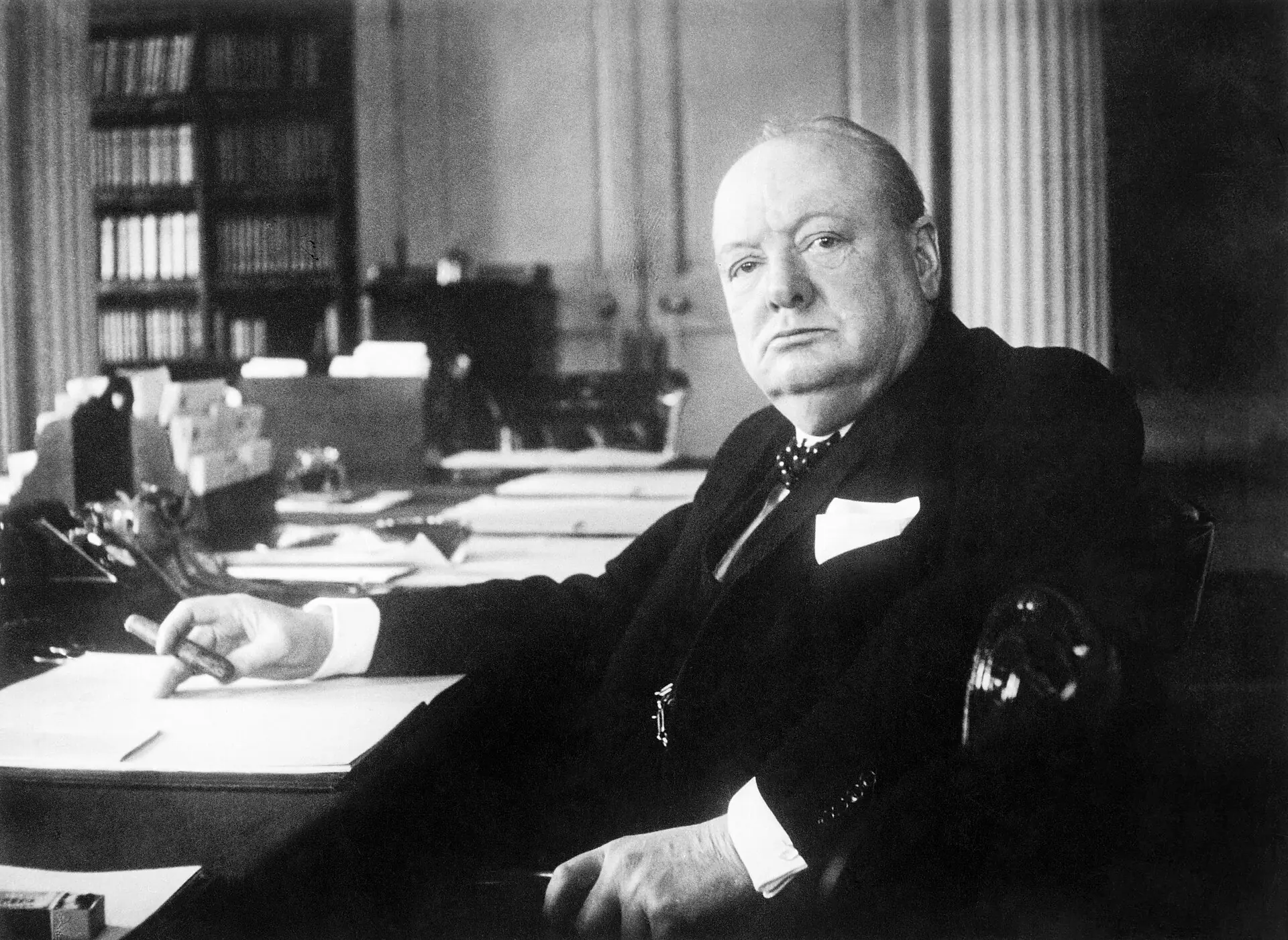 Winston Churchill
The man Britain needed most. The life of the soldier, reporter and twice prime minister who led Britain through the Second World War: eleven chapters, the cabinet of May 1940, the map of his journeys and wars, the people around him and the case for and against.
Read the life
(opens in a new tab)
The timeline is built from the project's own research dossier and its event, ruler, prime minister and map datasets, checked against English Wikipedia, Encyclopaedia Britannica, World History Encyclopedia and scholarly references. Linked articles are starting points for verification, not proof that every claim has been independently checked. Dates before 776 BCE are approximate and some, like the eruption of Thera, are disputed; Greek dates before 1 March 1923 follow the Julian (Old Style) calendar; historical borders are reconstructions.
Every event and every ruler has its own sources. See Sources & Further Reading in each timeline entry and ruler profile.
History is connected. Explore the bigger picture.
AllHistories is an independent visual history project designed to make the past easier to understand, explore, and connect.
History is more than a collection of dates, rulers, and battles. Events rarely happen in isolation. Borders shift, civilizations influence one another, ideas spread, and decisions made centuries ago continue to shape the world today.
Through interactive timelines, historical maps, and visual storytelling, AllHistories helps uncover these connections and makes complex historical subjects more accessible and engaging.
Travel through centuries, discover turning points, and understand how historical events unfold and connect.
Explore how borders, civilizations, populations, trade routes, beliefs, and spheres of influence have changed over time.
Go beyond dates and discover the individuals, places, decisions, and circumstances behind historical developments.
Explore connections between countries, empires, civilizations, and historical themes to better understand cause and consequence.
Features vary depending on the historical subject.
AllHistories draws on historical research, published references, public archives, and available historical datasets. The information is organized and presented through interactive digital experiences.
History is not always certain or universally agreed upon. Dates, territorial boundaries, population figures, and interpretations may differ between sources. Some information is necessarily simplified or estimated for visual presentation.
The goal is to encourage curiosity and independent exploration, not to replace academic publications or specialist historical research.
When you visit AllHistories, the web server may process technical information such as your IP address, requested pages, browser details and access times to deliver pages and maintain the service.
Some pages load Google Analytics, Google Fonts, externally hosted images, maps or other third-party resources. Requests to these providers can transmit technical information, including your IP address. Contact forms may use Google reCAPTCHA to help prevent abuse. These providers apply their own privacy policies.
The website uses browser storage for preferences such as the selected theme. Country microsites also use a session cookie to support website functionality, including request protection. Analytics or other third-party services may use additional cookies or storage, depending on the page and your browser settings.
When you submit a correction or contact form, the information you provide, such as your name, email address and message, is processed to review and respond to your request. Please avoid including sensitive personal information.
You can manage cookies and site storage in your browser and control third-party requests through browser privacy settings. For privacy questions or requests concerning information you submitted, use the contact option on the microsite where you sent it.
Links to sources and other websites take you to services with their own privacy practices. Review their policies before providing personal information.
AllHistories provides historical information for general education and exploration. Its content is not professional, legal, financial or other specialist advice.
We aim to present useful, well-sourced summaries, but cannot guarantee that every date, statement, translation or interpretation is complete or accurate. Verify important claims against the cited sources and relevant scholarship. Content may be corrected or updated.
Maps are simplified historical illustrations. Borders, place names and territorial labels may vary by period and source. Their appearance does not express a position on sovereignty or present-day territorial disputes.
Images and source material may belong to their respective creators or rights holders. Consult the image credit, source page and license before reusing material. A link or credit does not grant additional reuse rights.
External links are provided for reference. AllHistories does not control the content, availability or policies of third-party websites.
To report an error or a concern about credited material, use the contact option on the relevant country microsite and identify the page, material and supporting details.