Key facts of the era
Key Events
Scroll through five thousand years of dynasties, meet the rulers, and explore the moments that shaped China.
Explore China’s kings, emperors, presidents and paramount leaders — the main line of succession, and the rival states that ruled alongside it.
One of the world’s oldest continuous civilisations, ruled by dynasties for more than two thousand years before revolutions brought a republic in 1912 and the People’s Republic in 1949.
Farming villages along the Yellow River and the Yangtze grew into Bronze Age kingdoms, and under the Shang diviners were already writing on oracle bones. In 221 BCE the king of Qin defeated the last rival states and named himself First Emperor, Qin Shi Huang.
Dynasties then rose and fell for two thousand years, from the Han and the outward-looking Tang to the Song, whose cities and inventions were the most advanced of their age. Mongol rule under the Yuan gave way to the Ming, and in 1644 the Manchu Qing took Beijing.
Defeat in the Opium Wars and a string of unequal treaties weakened the empire, and the Xinhai Revolution brought it down: the Republic of China was founded on 1 January 1912. Warlord rule, civil war and the Japanese invasion of 1937 followed.
Mao Zedong proclaimed the People’s Republic in Beijing on 1 October 1949, while the Republic of China government withdrew to Taiwan, which it still governs and whose status remains disputed. From 1978 the reforms of Deng Xiaoping opened the economy, and China grew into one of the largest economies in the world.
World Bank mid-year estimates for mainland China; Hong Kong and Macao are counted separately. Growth slowed for three decades, and since 2022 the number has been falling.
The 14 countries that share a land border with China
 Mongolianorth
 Kazakhstannorth-west
 Kyrgyzstanwest
 Tajikistanwest
 AfghanistanWakhan Corridor
 Nepalsouth
 Bhutansouth

A red field with one large and four smaller golden stars, designed by Zeng Liansong and approved in September 1949. It was first raised in Tiananmen Square on 1 October 1949; officially the large star stands for the Communist Party and the small ones for the people united around it.
Image credits
Pictures on this page, from Wikimedia Commons and Natural Earth
 Great Wall at JinshanlingJakub HałunCC BY-SA 3.0
 Kangxi EmperorAnonymous Qing court painterPublic domainFlag of ChinaDrawn for this collagePublic domain (national flag)Flag of MongoliaWikimedia Commons (after Mongolian standard MNS 6262:2011)Public domain (state symbol, PD-Mongolia-exempt)Flag of KazakhstanShaken Niyazbekop (after the official measurements)Public domain (state symbol, PD-KZ-exempt)Flag of KyrgyzstanShakiev N.T., Primov U.B.Public domain (state symbol, PD-KG-exempt)Flag of TajikistanUnknown authorPublic domain (state symbol, PD-TJ-exempt)Flag of Afghanistan (2013–2021 design, as on this site’s Afghanistan pages)Government of Afghanistan (SVG: Wikimedia Commons contributors)Public domainFlag of NepalDrawn by Pumbaa80 and Achim1999Public domain (PD-Nepal)Flag of BhutanWikimedia Commons contributors (see file history)Public domain (PD-Bhutan)
From the First Farmers to the People’s Republic, 7000 BCE – Today
Nine thousand years on one map: Neolithic villages, the Shang and Zhou heartlands, the empires of the Han, Tang, Yuan and Qing, the ages of division between them, and the two Chinas of today. Move to any year, or follow 60 narrated chapters.
Move the slider to any year: every state recorded for that year is drawn. Chinese states in focus in the current chapter are gold, other Chinese states bronze, and neighbouring states grey; 60 chapters carry the story, and the dashed line is the People’s Republic of China today, for orientation. Hover a territory for its name and dates; click it to open its Wikipedia article. Before about 1600 BCE there are no state borders, so the earliest chapters show archaeological sites. Pre-modern borders are approximate reconstructions: frontier zones, tributaries and protectorates (such as the Tang protectorates in Central Asia) are drawn as solid territory where the dataset includes them, and areas are the size of those polygons, not of effective control. Conquest dynasties that ruled Chinese territory (Liao, Jin, Yuan, Qing) count as Chinese states. Taiwan, Tibet, Aksai Chin, Arunachal Pradesh and the South China Sea are disputed; the map shows de facto control as recorded in the dataset.
The Gengshi Emperor was executed.
 Gengshi Emperor
Emperor
11 March 23 – November 25
If the page stays blank, the site doesn't allow embedding — use “Open in new tab”.
China’s legacy is vast and contested: its writing, philosophy, inventions and art shaped much of Asia and the wider world, while its imperial past, revolutions and rise as a modern power continue to shape politics today.
Chinese characters have been written continuously for more than three thousand years, from Shang oracle bones to modern simplified script. The classical canon, Tang poetry and the great Ming and Qing novels shaped literature across East Asia, where Korea, Japan and Vietnam long wrote in Chinese.
Confucian ideas of family, ritual and virtuous government, Daoist thought and Chinese forms of Buddhism such as Chan (Zen) became the shared philosophical and religious inheritance of East Asia, and still shape ethics and daily life.
Qin and Han rulers built a centralised empire run by salaried officials. From the Sui and Tang to 1905, civil-service examinations selected officials by merit in the classics — a model that impressed early modern Europeans and influenced modern civil services.
Paper, printing, gunpowder and the compass — the “Four Great Inventions” — along with porcelain, silk, the seismoscope and advanced hydraulic engineering spread from China across Eurasia and helped transform the world.
Silk, tea and porcelain travelled west along the Silk Road and maritime routes for two millennia, while Buddhism, new crops and New World silver flowed in. China’s demand for silver and Europe’s demand for tea shaped the early global economy.
Bronze vessels, jade, calligraphy, landscape painting, blue-and-white porcelain and garden design defined Chinese aesthetics. The Great Wall, the Grand Canal and the Forbidden City remain among the largest works of human construction.
Dynasties founded by Han Chinese, Xianbei, Khitan, Jurchen, Mongol and Manchu rulers built a multi-ethnic empire whose borders the Qing more than doubled. That imperial legacy still shapes debates over Tibet, Xinjiang, Hong Kong and Taiwan.
The fall of the empire, the Republic, war with Japan and the Communist revolution transformed Chinese society. Mao’s campaigns brought famine and upheaval; reform after 1978 lifted hundreds of millions out of poverty and made China a global power.
Some chapters of China’s past are too big for a single timeline entry. Each of these has a site of its own, with maps, people, sources and the full story, told from start to finish.
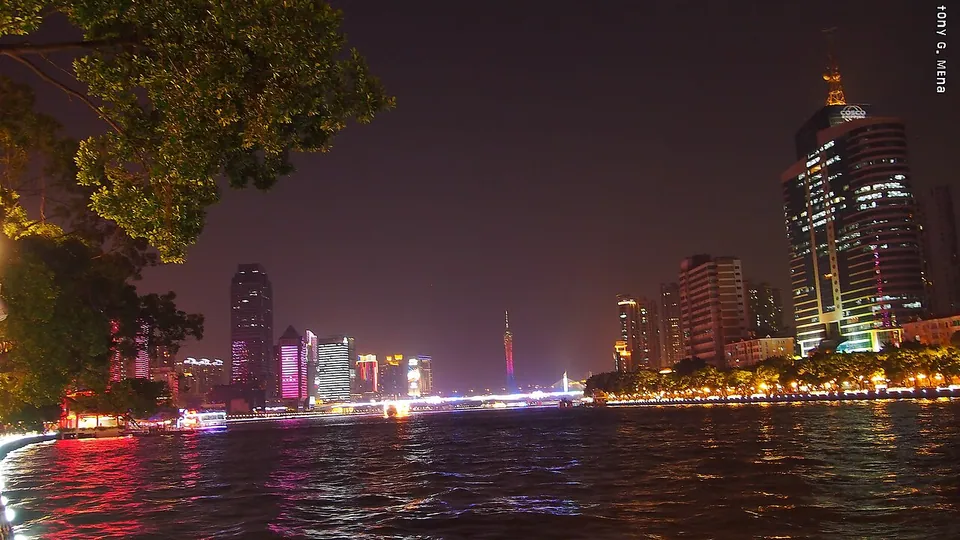 Guangzhou
Where China Met the Sea How a Qin garrison on the Pearl River became a royal capital, the Maritime Silk Road's great port, Canton of the tea and opium trade, the base of Sun Yat-sen's revolution and a megacity of 19 million.
Read the story
(opens in a new tab)
 Shanghai
Built on mud. Opened by gunboats. Raised to the sky. A county town on the Yangtze mud flats, forced open by the Opium War, became a city of foreign concessions, revolution and war, then a megacity of towers across the Huangpu.
Read the story
(opens in a new tab)
The timeline is built from the project's own research exports, checked against English Wikipedia, museum collections and scholarly histories. Many timeline entries are adapted from Wikipedia's Timeline of Chinese history under CC BY-SA 4.0 and are credited on their own pages. Dates before 841 BCE are traditional or approximate, and the historical borders on the map are reconstructions.
Every event and every ruler has its own sources. See Sources & Further Reading in each timeline entry and ruler profile.
History is connected. Explore the bigger picture.
AllHistories is an independent visual history project designed to make the past easier to understand, explore, and connect.
History is more than a collection of dates, rulers, and battles. Events rarely happen in isolation. Borders shift, civilizations influence one another, ideas spread, and decisions made centuries ago continue to shape the world today.
Through interactive timelines, historical maps, and visual storytelling, AllHistories helps uncover these connections and makes complex historical subjects more accessible and engaging.
Travel through centuries, discover turning points, and understand how historical events unfold and connect.
Explore how borders, civilizations, populations, trade routes, beliefs, and spheres of influence have changed over time.
Go beyond dates and discover the individuals, places, decisions, and circumstances behind historical developments.
Explore connections between countries, empires, civilizations, and historical themes to better understand cause and consequence.
Features vary depending on the historical subject.
AllHistories draws on historical research, published references, public archives, and available historical datasets. The information is organized and presented through interactive digital experiences.
History is not always certain or universally agreed upon. Dates, territorial boundaries, population figures, and interpretations may differ between sources. Some information is necessarily simplified or estimated for visual presentation.
The goal is to encourage curiosity and independent exploration, not to replace academic publications or specialist historical research.
When you visit AllHistories, the web server may process technical information such as your IP address, requested pages, browser details and access times to deliver pages and maintain the service.
Some pages load Google Analytics, Google Fonts, externally hosted images, maps or other third-party resources. Requests to these providers can transmit technical information, including your IP address. Contact forms may use Google reCAPTCHA to help prevent abuse. These providers apply their own privacy policies.
The website uses browser storage for preferences such as the selected theme. Country microsites also use a session cookie to support website functionality, including request protection. Analytics or other third-party services may use additional cookies or storage, depending on the page and your browser settings.
When you submit a correction or contact form, the information you provide, such as your name, email address and message, is processed to review and respond to your request. Please avoid including sensitive personal information.
You can manage cookies and site storage in your browser and control third-party requests through browser privacy settings. For privacy questions or requests concerning information you submitted, use the contact option on the microsite where you sent it.
Links to sources and other websites take you to services with their own privacy practices. Review their policies before providing personal information.
AllHistories provides historical information for general education and exploration. Its content is not professional, legal, financial or other specialist advice.
We aim to present useful, well-sourced summaries, but cannot guarantee that every date, statement, translation or interpretation is complete or accurate. Verify important claims against the cited sources and relevant scholarship. Content may be corrected or updated.
Maps are simplified historical illustrations. Borders, place names and territorial labels may vary by period and source. Their appearance does not express a position on sovereignty or present-day territorial disputes.
Images and source material may belong to their respective creators or rights holders. Consult the image credit, source page and license before reusing material. A link or credit does not grant additional reuse rights.
External links are provided for reference. AllHistories does not control the content, availability or policies of third-party websites.
To report an error or a concern about credited material, use the contact option on the relevant country microsite and identify the page, material and supporting details.